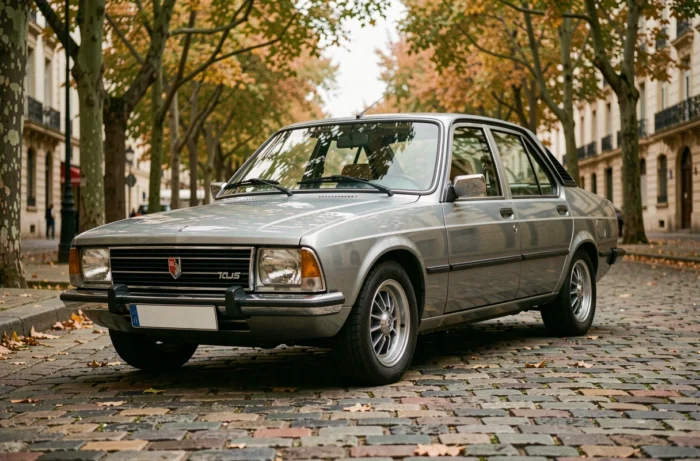
The Renault 30 is often labeled as a V6 sedan, featuring the famous PRV engine shared with Peugeot and Volvo. What this interpretation overlooks is that the original project aimed for a completely different caliber: a V8 for grand touring, designed to compete with the Citroën DS in the French luxury segment.
Understanding the Renault 30 requires looking back at this abandoned V8 and assessing how the V6 that succeeded it transformed the initial ambition.
From Project H to V6 PRV: What the Abandoned V8 Bequeathed to the Renault 30
The starting point is in the 1960s, under the code name Project H. Renault and Peugeot jointly developed a high-end rear-wheel-drive sedan, equipped with a 3.5-liter V8 designed by Peugeot, paired with a four-speed manual transmission.
The prototype exists, it runs. But the project was canceled in early 1967, as the demand for such vehicles was deemed too narrow, especially outside France. The V8 disappeared from the plans.
A few years later, the 1973 oil crisis definitively buried any idea of eight cylinders at Renault. The PRV consortium (Peugeot-Renault-Volvo) took the architecture of the abandoned V8 and reduced it to six cylinders. The result is a V6 opened at 90° instead of the usual 60° for this type of engine, a direct legacy of the original V8 configuration.
This unusual angle has concrete consequences: more pronounced parasitic vibrations, the need for a crankshaft with offset throws to balance the operation. The PRV engineers had to compensate for a structural compromise that neither Peugeot nor Volvo had initially planned for a six-cylinder. To learn everything about the Renault 30 V8, one must start from this technical lineage between the aborted V8 and the mass-produced V6.
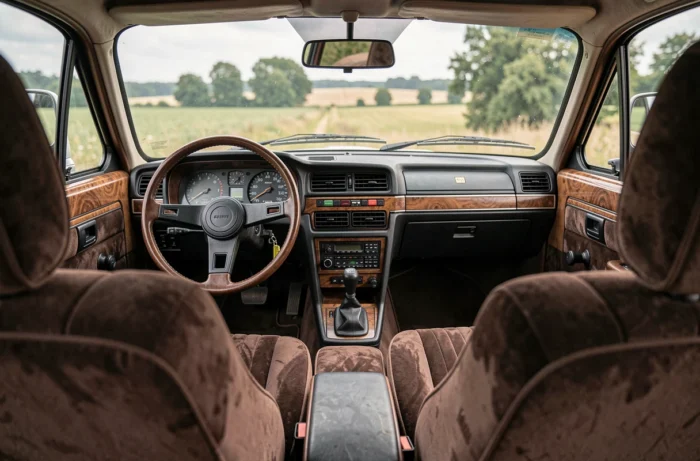
Technical Specifications of the V6 PRV: Comparison Between Versions of the Renault 30
The Renault 30 underwent several mechanical evolutions between 1975 and 1983. The table below summarizes the available data on the main versions.
| Version | Launch | Engine | Features |
|---|---|---|---|
| R30 TS | March 1975 (Geneva Motor Show) | V6 PRV | Launch version, carburetor-fed |
| R30 TX | – | V6 PRV with injection | Aluminum wheels, chrome center cap, Bosch injection |
The 1975 TS version suffers from carburetor feeding that limits the V6’s potential. It is the TX that marks the real turning point with the adoption of Bosch injection, which is more precise and better suited to the PRV’s 90° architecture.
On the other hand, the initial R30 TS consumes more than expected for its category, a flaw directly related to the V6’s angle compromise. The TX partially corrects this issue, without completely eliminating it.
Innovations of the Renault 30 Compared to Its Contemporaries
The Renault 30 is not just about its engine. Its two-body design with a rear hatch was, in 1975, a rare offering in the grand touring segment. Neither Mercedes nor BMW offered a high-end model with this configuration at the time.
- The rear hatch provides a modifiable loading volume, unusual for a prestige sedan at that time, and foreshadows the liftback formats that would become widespread in the 1980s.
- The front-wheel drive, combined with a V6 engine, represents a bold technical choice: most European competitors (BMW Series 5, Mercedes W123) remained loyal to rear-wheel drive.
These choices have a downside. Front-wheel drive with a V6 overhang generates pronounced understeer, a point that automotive press of the time regularly noted. The Citroën CX, its direct rival in the French market, offers hydropneumatic suspension that better absorbs road imperfections, whereas the Renault 30 remains more conventional.
The Renault 30 in the Classic Car Market
Produced in 136,403 units between 1975 and 1983, the Renault 30 never reached the volumes of its little sister, the Renault 20. This relative rarity is beginning to attract the attention of enthusiasts of French classic cars.
The TX versions with injection, better preserved mechanically than the carbureted TS, are the focus of collectors’ interest. The presence of original aluminum wheels and the chrome center cap is a value criterion for models in original condition.
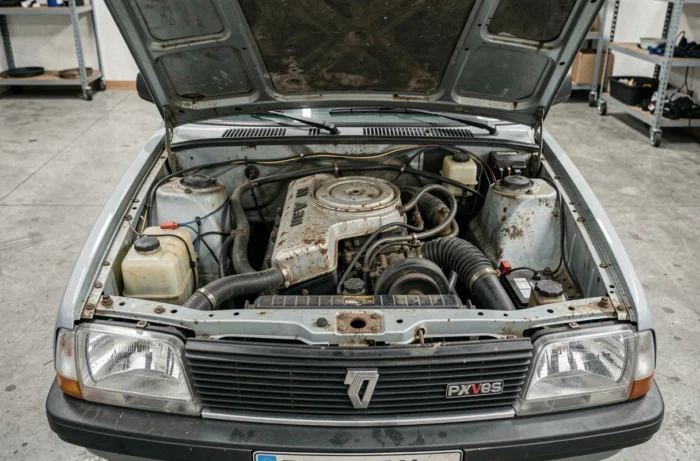
The V6 PRV raises specific maintenance questions. The 90° angle complicates access to certain components in the engine compartment, and spare parts are gradually becoming scarce.
The value of the Renault 30 evolves slowly compared to the Citroën DS or the Peugeot 504 Coupé, two French models of the same generation already well established in the classic car market.
Its interest lies more in its technical uniqueness than in its speculative value: a V6 derived from a V8, a two-body design in a conservative segment, and a place in the industrial history of the PRV consortium that powered three European manufacturers for nearly two decades.