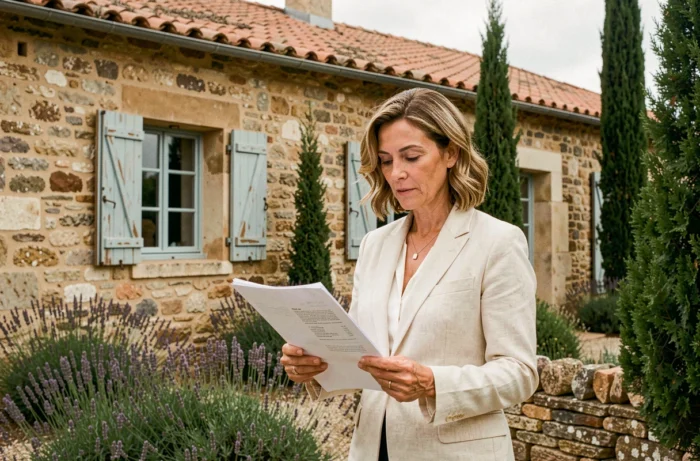
A couple is looking for a house with land in the Luberon, with a calibrated budget and a completed bank file. After three months of searching, all the properties visited are sold before the second visit or display prices that no longer match the estimates found online. The real estate market in Provence has been functioning this way for several quarters: fewer transactions, but prices that hold firm for quality properties. Understanding this mechanism before diving in changes the game.
PLU and urban planning constraints in Provence: what really blocks supply
We often talk about price per square meter, but rarely about what prevents the construction of new properties. The creation of regional natural parks and the tightening of local urban planning regulations in much of Provence significantly limit building permits. The concrete result: the stock of houses and buildable land is decreasing, and existing properties are gaining value due to scarcity.
For a buyer, this means that a buildable plot in the Aix region or the Alpilles is no longer negotiable as it was ten years ago. The Littoral Law, which prohibits any construction within 100 meters of the shoreline, adds another layer of constraint along the coastal areas of Var and Bouches-du-Rhône.
Before searching for a property, it is recommended to consult the PLU of the targeted municipality directly at the town hall or on the urban planning geoportal. A farmhouse with a possible extension on paper may be blocked by a classification as agricultural land or within a protected perimeter. Alpes Provence Immobilier assists with this type of verification in advance, which helps avoid wasting weeks on a non-viable project.
Real estate prices in Provence: where the real gaps between sectors lie
The Chamber of Notaries of Bouches-du-Rhône notes a significant decrease in the number of sales over the year (around -5.8%), but without a general decline in prices in the department. In Marseille, prices for older properties continue to rise, with an increase of about 3.6% in one year.
This paradox can be explained by the structure of demand. Buyers who remain active in the market have solid budgets and target specific properties. Well-located and renovated homes sell quickly, while others stagnate.
Aix-en-Provence and its outskirts: a measurable shift in demand
The historic center of Aix-en-Provence shows very high price levels, combined with an increasing difficulty in parking. Capital notes that the outskirts of Aix are gaining ground among households looking for a compromise between a Provençal lifestyle and a controlled budget. The municipalities in the Aix region offer larger spaces for a significantly lower price per square meter.
For a purchase project, it is advisable to broaden the search perimeter to these satellite municipalities rather than focusing on a saturated city center. Feedback on this point varies according to buyer profiles, but the trend is clear: mobility and parking weigh as heavily as price in the final decision.
Real estate in Provence: the selection criteria that matter on the ground
Searching for a property in Provence without a precise framework exposes one to unnecessary visits and pressured decisions. Here are the criteria that, concretely, make the difference between a rushed purchase and a well-managed one:
- Check the sustainability of the environment: a neighboring plot classified as buildable may accommodate a building in five years. The PLU and the land registry are the two documents to systematically request before any offer.
- Evaluate the real additional costs: property tax, maintenance of the garden and pool, energy consumption of an old stone house. These items represent a significant annual budget that many buyers underestimate.
- Anticipate climatic constraints: the mistral requires specific choices for windows and roofing. Salt corrosion along the Var coastline necessitates specific maintenance for ironwork and shutters.
- Inquire about the seasonality of the market: in Provence, real estate activity is stronger in spring and summer, driven by buyers of secondary residences. Searching in autumn or winter sometimes allows for negotiation with less competition.

Real estate appraisal: do not entrust this step solely to an algorithm
Online estimation tools provide a range based on recent transactions. In Provence, where each property has very specific characteristics (exposure, view, condition of the building, access), the gap between algorithmic estimation and actual selling price can be considerable. A local agent who knows the micro-market of a village or neighborhood remains the best filter for calibrating a purchase offer.
Purchase project in Provence: balancing between primary residence and rental investment
The rental market in Provence has seen significant growth in recent years, driven by seasonal demand and the residential appeal of the region. For a buyer who is hesitating between a primary residence and a rental investment, the question arises differently depending on the sector.
In tourist areas (Luberon, Alpilles, Var coastline), seasonal rentals generate regular income but require active management: cleaning between rentals, ongoing maintenance, compliance with local regulations on furnished tourism. A rental investment in Provence requires on-the-ground management, not just a yield spreadsheet.
For a primary residence, the calculation is different. One buys a lifestyle, not a return. The determining criterion then becomes proximity to transport links: the TGV station in Aix or the Marseille Provence airport opens up the possibility of a lifestyle shared between Provence and another city.
The Provençal market does not reward hesitation, but it does not forgive haste either. A well-prepared purchase, with a fine reading of urban planning constraints, a reliable local appraisal, and a search perimeter adjusted to the realities on the ground, remains the best strategy for finding a property that delivers on its promises over time.