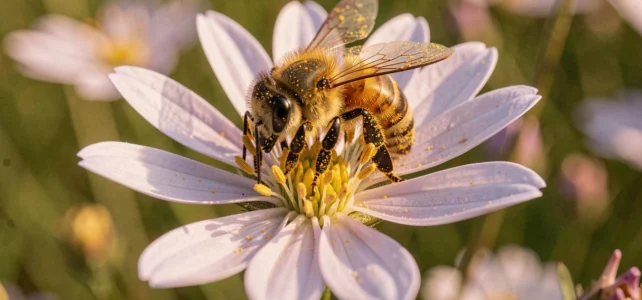
On an apple orchard, a single colony of bees can significantly impact the yield of an entire plot. Without repeated visits from foragers to the flowers, the fruits become misshapen, remain small, or do not form at all. The importance of bees for humanity begins here, in this discreet work of pollination that underpins a massive portion of our daily food supply.
Crop Pollination: What Bees Do in a Field
When a bee visits a zucchini or rapeseed flower, it transfers pollen grains between the male and female organs of the plant. This action, repeated thousands of times a day by each colony, enables fertilization and thus the formation of the fruit or seed.
According to the FAO, one third of global food production depends on bees and other pollinators. Nearly three-quarters of the plants that produce the majority of our food require this external help to reproduce properly.
We often talk about honeybees (Apis mellifera), but there are about 20,000 species of bees worldwide, nearly 2,000 of which are in Europe. Wild bees, often solitary, also contribute to pollination, sometimes on crops or flora that honeybees visit infrequently.
This complementarity between species is what makes the entire system effective. Initiatives led by Men and Bees help raise public awareness of this diversity, which is too often reduced to just the honeybee.
Urban Beehives and Wild Bees: When Good Intentions Create Pressure
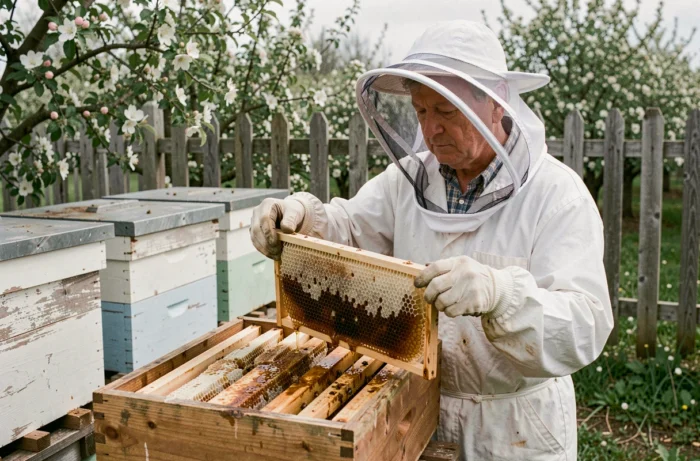
Installing beehives in the city has become an act perceived as ecological. We see them on the rooftops of businesses, town halls, and schools. The intention is commendable, but field reports show a side effect that few anticipate.
A study conducted by the Technische Universität München (TUM) highlighted that the rapid increase of urban beehives can harm wild bees. When the density of domestic colonies grows faster than the availability of flowers, both populations compete for the same resources. Wild bees, which do not have a hive or beekeeper to feed them in times of scarcity, are the first to suffer.
The issue is not having beehives in the city, but having too many relative to the floral capacity of the area. On this point, feedback varies according to local contexts, but the general trend points to a need for regulation.
What Can Be Observed at the Neighborhood Level
Within a radius of a few hundred meters around a concentration of beehives, there is often a decrease in the diversity of wild pollinator insects. Bumblebees, osmia bees, and andrenids find less available nectar. The challenge is not to eliminate urban beekeeping, but to proportion the number of beehives to the actual floral resources.
Pesticides and European Regulation: Measures That Change the Game for Colonies
Pesticides, particularly neonicotinoids, remain one of the major causes of bee colony decline. These substances affect the nervous system of insects, disrupting their orientation, foraging ability, and resistance to diseases.
Since 2018, the European Union has banned the outdoor use of the three main neonicotinoids: imidacloprid, clothianidin, and thiamethoxam. Only permanent greenhouses retain an authorization for use. In 2023, a new regulation further lowered the allowable residue limits for clothianidin and thiamethoxam to the lowest measurable level, with implementation scheduled for March 7, 2026.
This measure explicitly aims to protect pollinators, including against imported products. Crops treated outside the EU with these substances will no longer be allowed to enter the European market if they exceed these thresholds. This is a concrete change for agricultural sectors that export to Europe.
Risks That Persist Despite the Ban
- Residues of neonicotinoids remain in the soil for several years after treatments cease, continuing to affect insects that come into contact with these lands.
- Other families of pesticides, less publicized, can also disrupt colonies: fungicides, herbicides, and some new-generation insecticides whose effects on bees are still poorly documented.
- The Asian hornet (Vespa velutina), present in France since 2005, remains a direct threat to hives, particularly in the southern half of the country, and trapping devices do not always suffice to limit predation.
Bees and the Environment: Living Indicators of a Territory’s Health
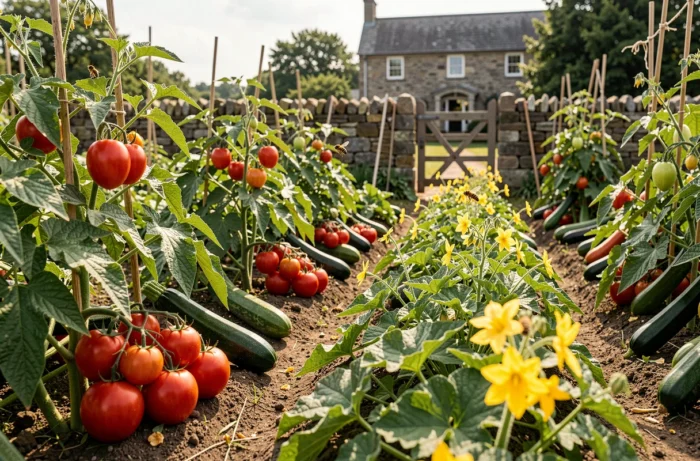
Bee colonies are increasingly used as biological sensors of environmental quality. The pollen, wax, and honey stored in a hive accumulate traces of pollutants present within a radius of several kilometers. Analyzing these matrices allows for mapping contamination in a territory from heavy metals, pesticide residues, or hydrocarbons.
This approach, known as apicultural biosurveillance, provides complementary results to traditional measurement stations. It covers a broader area and reflects the actual exposure of living organisms, not just the concentration in the air or soil at a given moment.
What Hives Teach Us About a Territory
- An abnormal mortality rate in a specific area can signal local contamination not detected by fixed sensors.
- The diversity of collected pollens provides information on the actual botanical richness of the landscape, far beyond what a one-time floral inventory can capture.
- Residues found in wax allow for tracking the evolution of pollution over several seasons, as wax is not renewed each year.
Bees are not an abstract symbol of biodiversity. They are a technical cog in food production, a warning signal about the chemical state of territories, and a battleground between good intentions (urban beehives) and real ecological balances. Protecting bees means first understanding their concrete constraints, from floral availability to pesticide regulations, before placing a hive on a roof.