
To reduce the share of emissions related to buildings, the Confederation and the cantons have been funding energy improvement measures through the Buildings Program for over a decade. This scheme covers both the renovation of the thermal envelope and the replacement of fossil heating systems, with amounts and conditions varying according to the canton where the property is located.
New incentive model planned for 2028: what changes for your project
The current framework for subsidies is not set in stone. The association of cantonal energy directors (EnDK) has announced that the Buildings Program will be merged with the Impulse Program into a new common Confederation-cantons model by 2028. This model aims to strengthen support for measures with the highest potential for CO₂ reduction and energy efficiency.
A consultation is scheduled for autumn 2026 as part of the revision of the energy ordinance. The granting criteria, priorities, and safeguards against windfall effects will be thoroughly reviewed.
For a property owner planning a medium-term renovation, this deadline has a direct consequence: submitting an application under the current regime may prove more advantageous than waiting for a scheme whose contours remain uncertain. The conditions for 2026-2027 are known, while those for 2028 are not yet clear. The platform Subventions Bâtiment allows you to check the available aids by canton before launching a project.
CECB Plus: the diagnosis that conditions your energy subsidies
The Cantonal Energy Certificate for Buildings (CECB) classifies a property’s performance on a scale from A (very efficient) to G (very energy-consuming). Its in-depth version, the CECB Plus, is not limited to a diagnosis: it offers a detailed renovation concept with several work variants.
In most cantons, submitting a CECB Plus is a prerequisite for obtaining a subsidy for insulation or heating replacement work. Without this document, the application is simply inadmissible.
What the CECB Plus concretely provides
- A comprehensive thermal assessment of the building’s envelope (roof, facade, floor, windows) and the heat production system
- Several renovation scenarios with cost estimates, expected energy savings, and potential subsidies per measure
- A documentary basis accepted by the cantonal energy services to process the subsidy application
The cost of the CECB Plus itself is sometimes partially subsidized depending on the canton. Checking this point before commissioning a certified expert helps avoid missing out on assistance for the diagnosis.
Renovation obligation according to energy class: a cantonal timeline is emerging
A draft regulation under discussion plans to impose renovation deadlines based on the CECB class of the building. Buildings classified as G should be renovated within ten years, F within fifteen years, and E within twenty years, starting from the registration of these obligations in the cantonal energy laws.
This mechanism is not yet in force everywhere, but it changes the financial logic of a project. Renovating before the obligation comes into effect allows for access to incentive subsidies, whereas a renovation mandated by law could reduce or even eliminate access to certain aids.
For owners of old buildings heated with fossil fuels, this regulatory signal justifies initiating a CECB Plus right now, even if the work is not planned for several years.

Cantonal subsidies in Switzerland: significant disparities depending on your location
The Buildings Program is based on a harmonized model, but each canton adapts the amounts, eligible measures, and procedures to its own energy policy. Two owners renovating an identical building in two different cantons may receive very different amounts.
Measures generally covered by the cantons
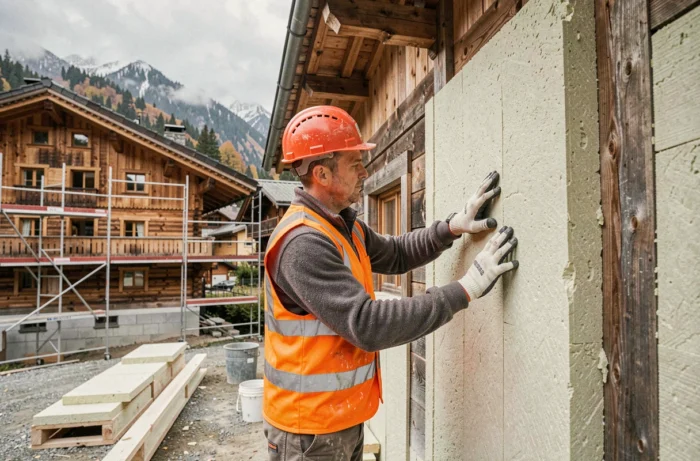
- Thermal insulation of walls, roofs, floors, and replacement of windows
- Replacement of a fossil heating system (oil, gas) with a heat pump, a solar thermal system, or wood heating
- Installation of photovoltaic solar panels (depending on the canton)
- Connection to a district heating network
Some municipalities and energy suppliers offer complementary aids that add to the cantonal subsidies. These funds are rarely centralized and require specific research with the municipality or local supplier.
Rule to respect before any construction work
The subsidy application must be submitted and approved before the start of the work. Starting a project and then applying for retroactive assistance is the most common reason for refusal. This rule applies in all cantons without exception.
The correct sequence is as follows: contact the cantonal energy service, carry out the CECB Plus, develop the renovation concept, submit the application, wait for the decision, and only then begin the work.
The transition to the new model in 2028 will redistribute priorities. Anticipating your energy renovation project within the current framework remains the clearest strategy to secure funding.