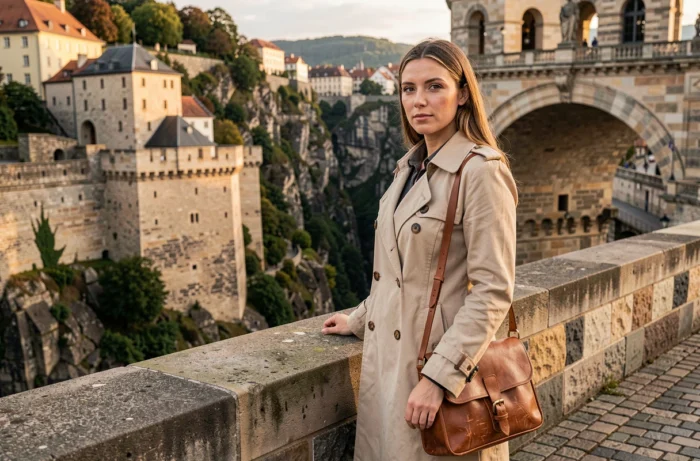
Luxembourg is often reduced to its image as a financial center. However, traveling in this country means crossing landscapes that change every thirty kilometers, moving from a forest plateau to a sandstone gorge, then to a river valley lined with vineyards. The Grand Duchy can be explored quickly, but it is discovered slowly.
Free transportation in Luxembourg: what it means for travelers
Since Luxembourg introduced free public transport, buses, trams, and second-class trains are now free of charge. For a visitor, this radically simplifies logistics.
You arrive at Luxembourg City station, hop on a bus or a regional train, and reach Vianden, Echternach, or Esch-sur-Sûre without ever pulling out your wallet. No ticket to validate, no app to download.
Free transport has especially improved short trips, particularly between the capital and its neighboring municipalities. For longer excursions to Oesling or Mullerthal, frequencies remain modest outside peak hours. Check the schedules the day before, especially on weekends.
The ideal is to combine the train for major routes and walking or biking for the last kilometers. You can access Your Travel Guide website to organize your stops between the different regions of the country.
Luxembourg City: the Grund district and the Bock casemates
The capital concentrates the majority of visits, and two sites alone justify an entire day.
Descending into the Grund
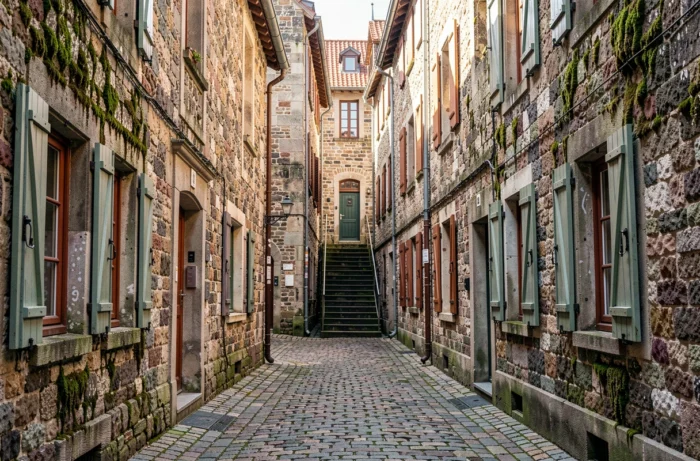
The Grund is the lower district of the city, nestled between the cliffs of the fortress and the Alzette River. It can be accessed via a panoramic elevator from the Saint-Esprit plateau or on foot via the stairs carved into the rock.
Down below, the atmosphere changes. Old mill houses, restaurants set in vaulted cellars, the Neumünster Abbey converted into a cultural center. The Grund offers a striking contrast to the modern city center located just a few dozen meters above.
The Bock casemates
The casemates are a network of underground galleries carved into the rocky promontory of Bock. They served as military defense and could shelter thousands of soldiers.
Today, they are visited for the view they offer over the Alzette valley and to understand why Luxembourg has been nicknamed “the Gibraltar of the North.” The Bock casemates are a UNESCO World Heritage site. Expect a good hour of visiting, and bring a jacket: the underground temperature remains cool even in summer.
Vianden Castle and the Sûre Valley: the other face of Luxembourg
Why leave the capital? Because the north of the country resembles the Belgian Ardennes more than a European metropolis, and that is precisely its charm.
Vianden Castle overlooks the town from a rocky ridge. It is one of the largest feudal castles in Western Europe. Its restoration, carried out over several decades, has restored its Romanesque and Gothic halls. The ascent from the village takes about twenty minutes on foot or by a chairlift that overlooks the Our River.
The Sûre Valley, further west, is the territory of green Luxembourg. The village of Esch-sur-Sûre, nestled in a bend of the river, is photographed from every angle, but it deserves more than just a photo. The trails that lead from the village offer viewpoints over the dam lake and the high-altitude forests. This area has seen significant growth in camping in recent years.
The camping boom in Luxembourg: a trend to know before booking
Classic guides point towards hotels in the capital or rural guesthouses. They overlook a significant evolution: the number of campers has jumped by about 50% compared to 2019, and overnight stays in campsites have increased by nearly 30% during the same period.
This increase mainly concerns two regions:
- Oesling (Luxembourg Ardennes), where campsites line the rivers and hiking trails. Demand has pushed some establishments to upscale, with equipped pitches and accommodations like cabins or pods.
- Mullerthal (Little Luxembourg Switzerland), whose rock formations attract hikers. Campsites serve as a base for the marked trails that wind between the sandstone gorges.
- The shores of the Haute-Sûre lake, popular for water activities and swimming in summer.
Practical consequence: booking a camping spot has become necessary during high season, especially between June and September. This was not the case a few years ago.
Four-day itinerary in Luxembourg: a regional breakdown
The country can be crossed in less than two hours by car, but spacing out the stops allows you to absorb the diversity of landscapes.
Day 1: Luxembourg City. Grund district, Bock casemates, Place Guillaume II, market at Place d’Armes if you happen to be there on a Wednesday or Saturday. The Grand Duke Jean Museum of Modern Art (Mudam) is worth a visit for its architecture designed by Ieoh Ming Pei.
Day 2: Mullerthal. Early train departure to Echternach, then hike on the Mullerthal Trail. The passages between the rock walls are spectacular. Wear suitable shoes, the terrain is wet.
Day 3: Vianden and the Our Valley. Visit the castle in the morning, descend into the village, lunch by the river. In the afternoon, stroll towards the Vianden dam or the surrounding forest trails.
Day 4: Esch-sur-Sûre and the Haute-Sûre lake. Hike around the lake, visit the village, return to the capital in the late afternoon by train.
This breakdown works well by car or public transport, as long as you adapt the schedules to regional lines.
Luxembourg does not require long vacations to reveal its best angles. Four days are enough to go from the underground galleries of the capital to the gorges of Mullerthal, then to the ridges of Oesling. The country lends itself to a slow pace, punctuated by free trains and forest trails that always lead to a castle or a lake.