Creating a board game with a French design studio is not just about drawing a board and writing rules. The French market shows a saturation of new products that makes technical and editorial differentiation crucial. This article measures the concrete parameters that separate a viable project from a prototype without follow-up: regulatory compliance, production trade-offs, and editorial positioning.
CE Compliance and European Toy Safety Regulation: What the Studio Must Check
Competitors rarely mention the regulatory dimension, yet it conditions market entry. The General Product Safety Regulation (GPSR), which came into effect at the European level, imposes a set of documentary and technical obligations on toy manufacturers before any commercialization in the Union.
A French design studio managing production from A to Z must anticipate these requirements from the prototyping phase. Materials used for tokens, printing inks, minimum size of pieces to avoid ingestion risks: every component of the game is affected.
Studios that outsource manufacturing to Asia must also ensure that their subcontractor complies with European safety standards, with supporting technical documentation. A partner like Ludika Studio integrates these regulatory constraints into its design process, which avoids costly back-and-forth between prototype and certification.
- Mandatory CE marking before sale, with a complete technical file accessible to market surveillance authorities
- Mechanical and chemical tests on each batch of components (tokens, cards, dice, boards)
- Traceability of the manufacturer and importer: name, address, and contact details on the packaging or in the documentation

French Board Game Market: Saturation of New Products and Shift to the Adult Segment
The board games and puzzles segment represents approximately 624 million euros in France. This figure does not tell the whole story: the internal dynamics of the market have shifted.
In 2024, sales of games for adults increased by 27% nationwide, while family games declined by 11%. This shift has direct consequences on the work of a design studio.
| Segment | Recent Trend | Implication for Design |
|---|---|---|
| Family Games | Decline of 11% | Very strong competition, difficult differentiation in this niche |
| Adult / Expert Games | Increase of 27% | Demand for deeper mechanics, mature themes, longer playtime |
| Custom Games (corporate, events) | Growth driven by gamification | Specific specifications, integration of brand messages |
A French studio proposing to create a “unique” game without considering this reality risks delivering a generic family product in a declining segment. In contrast, designing a mechanic for adult or expert players opens a space where demand exceeds current supply.
Custom Board Game Design: Technical Trade-offs That Change the Budget
The manufacturing cost of a board game varies according to parameters that studios do not always detail upfront. Three areas concentrate the majority of budget discrepancies.
Choice of Materials and Finishes
A compact cardboard board with matte lamination does not cost the same as a screen-printed wooden board. Molded plastic tokens remain the cheapest option, but solid wood or resin pieces reposition the game in a perceived premium range.
The choice of material determines both the unit cost and the editorial positioning of the game. A design studio guides this choice based on the identified target audience, not just the available budget.
Production Volume and Break-even Points
Small batch manufacturing (a few hundred copies) involves a significantly higher unit cost than industrial production. For a custom game intended for a corporate event, this extra cost is absorbed by the client’s communication budget. For a game intended for retail sale, the calculation changes radically.
An experienced studio offers several printing scenarios with associated costs, so that the project owner can make informed trade-offs between margin, selling price, and volume.
Illustration and Artistic Direction
The visual identity often represents the most variable cost. Hiring a recognized illustrator in the French gaming community is significantly more expensive than a generalist graphic designer, but the impact on the game’s visibility in specialized stores is measurable.
Prototyping and Playtesting: The Phase That Failed Projects Shortened
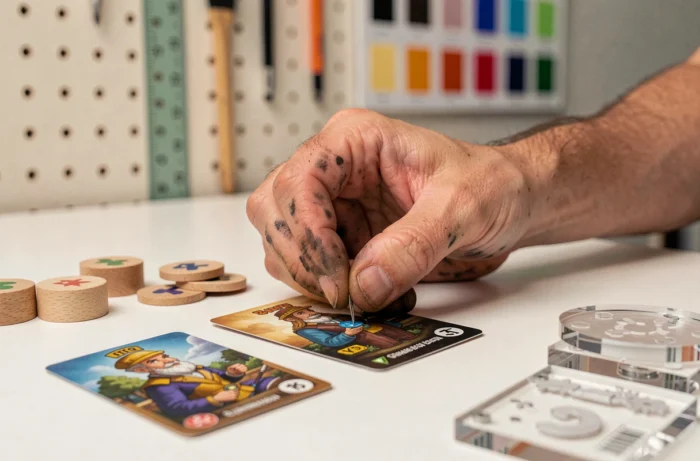
A board game cannot be validated on paper. Physical prototyping, followed by playtesting sessions with real players, remains the only reliable method to detect mechanical imbalances, downtime, and ambiguous rules.
Several testing cycles are necessary before finalizing the rules. French studios that integrate this step into their standard process deliver games with a lower return rate in stores.
- First functional prototype: basic components (homemade printed cards, generic tokens) to test pure mechanics
- Second prototype: integration of artistic direction, adjustment of ergonomics (card size, text readability)
- Final prototype: pre-production version submitted to a panel of external testers, with structured feedback collection
Shortening this phase to save time on the production schedule is the most common cause of disappointing games upon delivery. A serious design studio defends this testing time against the client’s scheduling constraints.
The French board game market rewards projects that combine technical rigor and clear editorial positioning. In the face of saturation in new products, differentiation comes from the quality of design, not from production volume. A studio that masters the entire chain, from regulatory compliance to final playtesting, offers a guarantee that self-publishing without support cannot provide.