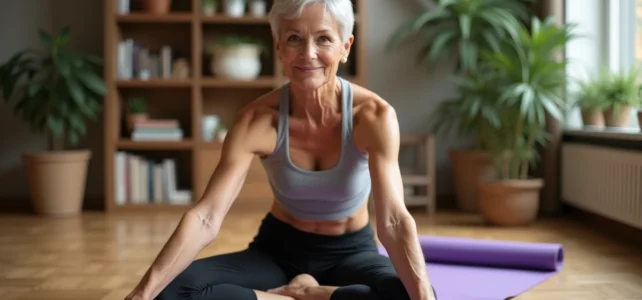
When you have knee pain getting up from the couch, exercising at home doesn’t seem obvious. However, physical activities at home after 60 have concrete advantages: no travel, no outside gaze, and the possibility to break up the effort throughout the day. The ARS Centre-Val de Loire reminds us that the WHO recommends at least 30 minutes of moderate exercise per day, which can be divided into 10-minute segments.
Breaking up effort daily: the logic of 10 minutes
Most guides talk about sessions of 30 or 45 minutes. In practice, many seniors give up because this format doesn’t match their energy levels for the day. Breaking it down into 10-minute blocks changes the game: you do one block in the morning after coffee, another before lunch, and a final one in the late afternoon.
This division is not a compromise. Recommendations shared by regional health agencies validate this approach for those over 65, combining walking within the home, balance exercises near a wall, and small resistance movements with a water bottle. We are indeed talking about senior physical activities at home that integrate into daily routines, not a rigid sports program.
Three blocks of 10 minutes are better than a 30-minute session that you never do. Housework, balcony gardening, or climbing stairs also count as moderate physical activity.
Senior muscle strengthening without equipment: what really works
You don’t need dumbbells to maintain muscle mass after 60. Body weight is sufficient, provided you target the right muscle groups. Here are the most suitable exercises for a small space:
- Chair stands: stand up and sit down slowly, 8 to 12 repetitions, controlling the descent. This exercise engages the quadriceps and glutes, two groups directly related to fall prevention.
- Wall push-ups: standing facing a wall, hands at shoulder height, bend the arms and then push back. Less strain on the wrists than on the floor, and it works the chest and triceps.
- Calf raises: feet hip-width apart, rise onto the balls of your feet and then lower slowly. This strengthens the calves and improves balance, two critical points after 65.
- Forearm plank (knees on the ground version): 15 to 30 seconds is enough to engage the abdominal belt without straining the back.
Muscle strengthening reduces the risk of falling much more than walking alone. It’s the often-overlooked pillar of home programs.
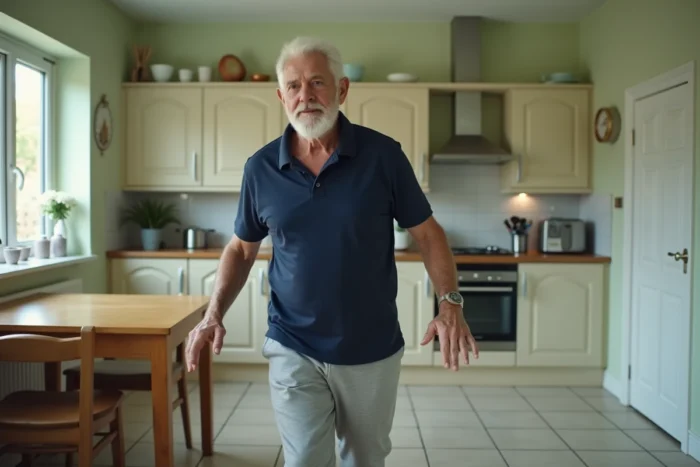
Chair yoga and tai chi: two practices suitable for reduced mobility
For those who cannot get on the floor, chair yoga represents a concrete alternative. Municipal guides for seniors present it as a practice suitable for all levels, allowing for strength, flexibility, and breathing exercises without leaving the chair.
It includes torso rotations, leg extensions, and side bends. Chair yoga works on flexibility and breathing without going to the floor. This is particularly relevant after 70 or in cases of knee osteoarthritis.
Tai chi in a small space
Tai chi requires only one or two square meters. The slow movements engage balance and coordination, two abilities that decline with age. Several free videos offer 10 to 15-minute sequences specifically designed for seniors.
Feedback varies on this point: some people find tai chi too slow at first, while others appreciate this slowness that forces them to stabilize each posture. In both cases, tai chi improves balance and coordination at any age.
Home exercise after 60: organizing a typical week
Alternating types of exercises throughout the week avoids monotony and covers the four recommended pillars: endurance, muscle strengthening, flexibility, and balance. Here’s an example of a schedule:
| Day | Activity | Duration |
|---|---|---|
| Monday | Strengthening (chair stands, wall push-ups) | 2 x 10 min |
| Tuesday | Indoor walking or stair climbing | 3 x 10 min |
| Wednesday | Chair yoga or stretching | 20 min |
| Thursday | Tai chi (guided video) | 15 min |
| Friday | Strengthening + balance (calf raises, plank) | 2 x 10 min |
| Saturday | Free activity (gardening, active housework) | 30 min |
| Sunday | Rest or light stretching | 10 min |
This schedule is not set in stone. The goal is consistency, not performance. Missing a day does not negate the benefits of the week.
The shift to home exercise in France
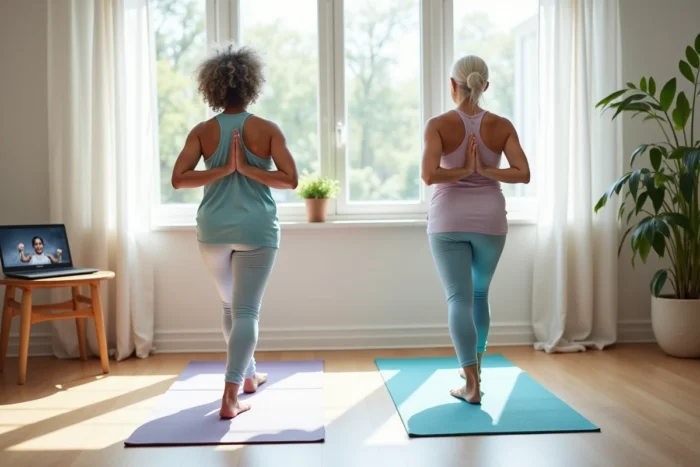
Home exercise is growing in France, especially among those over 60. Coaching apps, guided videos on screen, and video conference sessions with a sports educator: the formats are multiplying.
Some municipalities are starting to offer home exercise slots supervised by professionals, such as in Luc-sur-Mer where a service dedicated to seniors has been launched. Remote coaching makes physical activity accessible even in isolated rural areas.
Physical activity after 60 is not limited to daily walking. Muscle strengthening, chair yoga, tai chi: these practices can be done in a living room, without expensive equipment, and meet the real needs of the aging body. Ten minutes a day, three times a week, is enough to trigger measurable improvements in balance and strength.