
A protective grille installed on a window in a condominium changes the exterior appearance of the building. This simple technical fact triggers a cascade of legal obligations that most co-owners underestimate, and that competing articles rarely address from the concrete procedural angle.
Reversible fixing and common areas: the technical criterion that conditions the entire file
The method of fixing the grille determines the legal qualification of the work. A hole in the facade masonry affects a common area, even if the window itself is a private lot. We observe that this point generates the majority of disputes between co-owners and property managers.
The reversible fixing is the most acceptable solution in a condominium, because it limits the impact on common areas and allows for removal without trace. In practical terms, this means light sealing brackets or screw systems in the frame of the carpentry rather than chemical anchors in the load-bearing wall.
To prepare a solid file for the general assembly, we recommend consulting the available resources, particularly regarding habitatfuturvert registration and carpentry lemagazinedubricoleur.fr, which detail the voting rules and best practices for installation in a condominium.
The choice of material also plays a role: a galvanized steel grille with a low visual section will be more easily accepted than an ornate wrought iron grille that alters the architectural character of the facade.
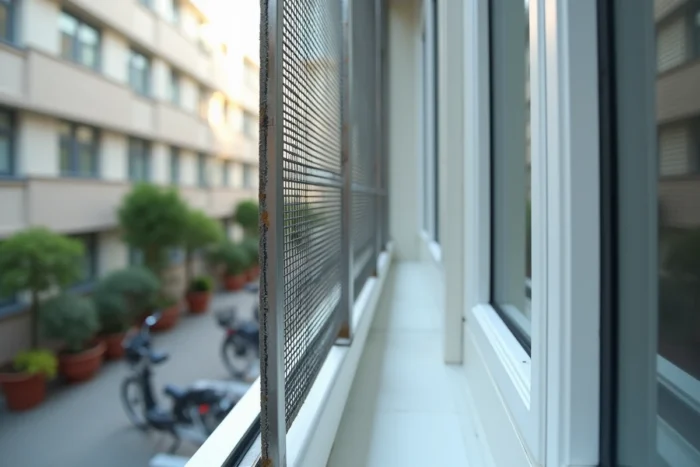
Vote in the general assembly: applicable majority and procedural traps
A grille that alters the exterior appearance requires authorization from the co-owners in the general assembly. The required majority depends on the exact nature of the work and the provisions of the condominium regulations. Failing to submit the request for a vote exposes the co-owner to legal action for restoration.
Building a convincing technical file for the property manager
The file submitted to the property manager benefits from being technical and visual. We recommend including:
- A precise description of the material (steel, aluminum, welded mesh), the section of the bars or wire, and the surface treatment (galvanization, powder coating)
- The exact dimensions of the grille and its method of fixing, with a dimensioned diagram
- The chosen color, ideally matching the existing carpentry or the RAL imposed by the regulations
- A visual in context (photo montage on the facade) or a physical sample
An incomplete file will be returned or rejected by the council before even reaching the agenda of the assembly. The level of technical detail reassures other co-owners about the aesthetic integration of the device.
Special case: restrictive condominium regulations
Some regulations prohibit any modification of the facade without exception. In this case, even a favorable vote is not enough: the regulation itself must first be amended, which requires a reinforced majority. We observe that this subtlety regularly traps co-owners who have obtained a positive vote without checking the facade harmony clause.
Window protective grille: choice of type and spacing constraints
The term “protective grille” encompasses very different realities in a condominium. Defensive bar grille, welded mesh panel, or metal net do not meet the same uses or normative requirements.
For anti-intrusion security, the defensive bar grille remains the standard. The spacing between bars must not allow the passage of a child’s head, which leads to a spacing of no more than eleven centimeters. This criterion, derived from standards related to guardrails, is often adopted by insurers as a condition of compliance.
The welded mesh panel is more suitable for protection against falling objects or animals. Its visual discretion makes it easier to accept in a condominium, but its resistance to break-ins is significantly lower than that of a solid steel grille.
The price varies greatly depending on the material and type of installation (in frame, externally applied, in rebate). An installation in frame, embedded in the window opening, is less visible from the street and generates less opposition in the assembly.
Maintenance and responsibility of the co-owner after installation
Once the grille is authorized and installed, maintenance remains the exclusive responsibility of the benefiting co-owner. This point is rarely documented, even though it engages the civil liability of the owner in case of failure.
Regular maintenance involves an annual check of the fixings, anti-corrosion treatment if the grille is made of non-stainless steel, and the replacement of degraded screws or sealing brackets. A poorly maintained grille that detaches from the facade engages the responsibility of the co-owner towards third parties and other occupants of the building.
In the event of a sale of the lot, the grille remains a private facility. The buyer takes over the maintenance responsibility, but the seller must report any known non-compliance. If the grille was installed without authorization from the general assembly, the property manager can demand its removal at any time, even after a change of ownership.

The condominium remains a framework where individual security is negotiated collectively. A complete technical file, a reversible fixing method, and a color consistent with the facade constitute the three concrete levers to obtain the green light in the assembly, without generating subsequent disputes.