
Plugging in an air cooler in a poorly ventilated room on a heatwave evening is the kind of situation where you quickly find out if the device lives up to its promises. The Klarstein Maxfresh 6 L is one of those models that frequently appears in comparisons without ever knowing exactly what to expect in daily use. With a 6-liter tank, 4-in-1 function, and remote control: the technical specifications check many boxes, but the real-world experience deserves attention.
Klarstein Maxfresh vs. Whirlwind: two 6 liters, two approaches
Klarstein markets another cooler equipped with a 6-liter tank, the Whirlwind, with an air flow rate of 320 m³/h and a coverage area of 30 m². The Maxfresh boasts a significantly higher flow rate of 444 m³/h. On paper, the difference is clear.
In practice, a higher flow rate does not guarantee a more pronounced cooling effect. The Maxfresh pushes more air, but the feeling of coolness also depends on the type of ventilation (oscillating or fixed), ambient humidity, and room size. We consulted the Klarstein Maxfresh 6 L test to cross-reference field feedback with manufacturer data, and the conclusion often comes back: the cooling gain remains moderate in rooms larger than 20 m².
The Whirlwind, with a lower flow rate, offers three modes and a comparable timer. For a closed bedroom or office, both models are equivalent. The Maxfresh takes the advantage in an open living room or shared workspace, where the reach of the airflow matters more.

6-liter tank and cooling packs: real autonomy of the Maxfresh
The 6-liter tank is one of the recurring selling points of this model. Filled with cold water along with the provided cooling packs, it powers the evaporation system for several hours without intervention. It’s a decent size for nighttime use or an afternoon of remote work.
The cooling effect diminishes as the water warms up. Without refreshing the ice packs, the feeling of coolness is lost after a few hours. Feedback varies on this point depending on the ambient temperature and humidity level of the room.
- Top filling, accessible without moving the device, making it easy to refill during use
- Two cooling packs included, to alternate between the tank and the freezer for continuous cycling
- Water level visible on the side of the tank, useful for anticipating refills without opening the compartment
This system works well in a rotation logic: while one pack cools in the freezer, the other works in the tank. Having two additional packs prevents interruptions during the hottest days.
Noise and ventilation modes: how the Maxfresh performs at night
The Maxfresh offers three modes (normal, natural, night) and four speeds. The night mode reduces the fan power and dampens the noise, but does not eliminate it. At the lowest speed, the airflow remains audible in a quiet room.
This is a classic compromise for coolers in this range: a high airflow implies a noisier motor compared to models at 300 m³/h. The natural mode alternates speeds to simulate a breeze, making the noise less monotonous and easier for some users to ignore.
The remote control allows you to change modes without getting up, a nice detail at night. The programmable timer shuts off the device after a set period, preventing it from running until morning when the temperature drops.
Oscillation and airflow reach
The side oscillation distributes air over a fairly wide arc. In a studio or rectangular room, you feel the airflow passing regularly. In a large living room, the cooling effect concentrates on the area facing the device. Placing the Maxfresh close to your workstation or bed yields better results than leaving it in the center of an open room.
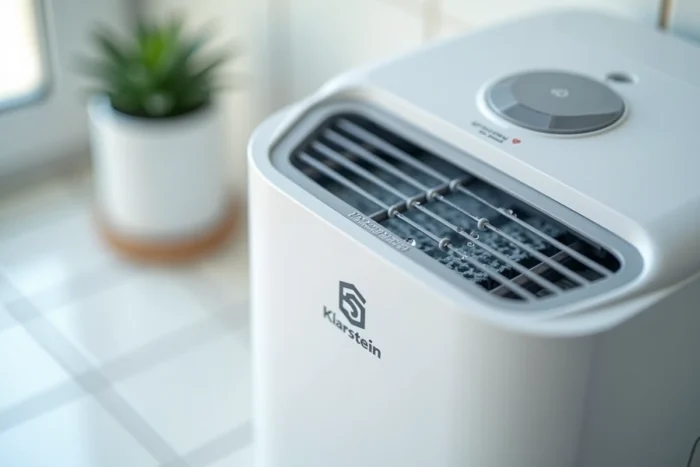
Positioning the Klarstein Maxfresh among coolers in 2025
Recent comparisons reveal coolers with more advanced features: optimized eco modes, connectivity, active noise reduction. The Maxfresh does not offer any of this. Its positioning remains that of a reliable mid-range model, without technological pretensions.
This lack of advanced features is not a flaw if you’re looking for a simple-to-use device. No app to install, no Wi-Fi connection to configure. You plug it in, fill it up, and turn it on. For seasonal use in a second home or a spare office, this simplicity makes sense.
- Four combined functions: fan, cooler, humidifier, ionizer
- Physical controls on the top panel in addition to the remote control
- Built-in wheels for easy movement from one room to another
Online reviews converge towards an average satisfaction: the Maxfresh fulfills its mission without excessive enthusiasm. We’re not talking about a device that replaces air conditioning, but rather a complement that lowers the perceived temperature by a few degrees in a targeted space. Keeping this expectation in mind before purchasing avoids disappointments.