
Officially declaring one’s residence in a campsite or mobile home in France raises a specific legal question: the law distinguishes between administrative address, tax residence, and effective residence. These three concepts do not always overlap, and their interplay determines what is actually possible for a person living in mobile housing.
Administrative residence, tax residence, and effective residence: three statuses to distinguish
| Concept | Definition | Applicable to mobile home or campsite |
|---|---|---|
| Administrative residence (election of residence) | Address obtained through a CCAS, CIAS, or an approved organization to exercise civil rights | Yes, by right (article L.264-1 of the Code of Social Action and Families) |
| Main residence (tax law) | Place of effective and habitual occupation of the taxpayer | Yes, if effective occupation is verified, regardless of the declared address |
| Residence in the sense of the Civil Code | Place of principal establishment (article 102 of the Civil Code) | Possible, but subject to the land use regulations |
This table highlights a frequent discrepancy. A person may reside in a mobile home year-round without having a traditional postal address, or conversely, hold an administrative address elsewhere while effectively living on a campsite plot.
The question of declaring one’s residence in a campsite therefore depends on the type of residence being sought and the legal framework of the land.
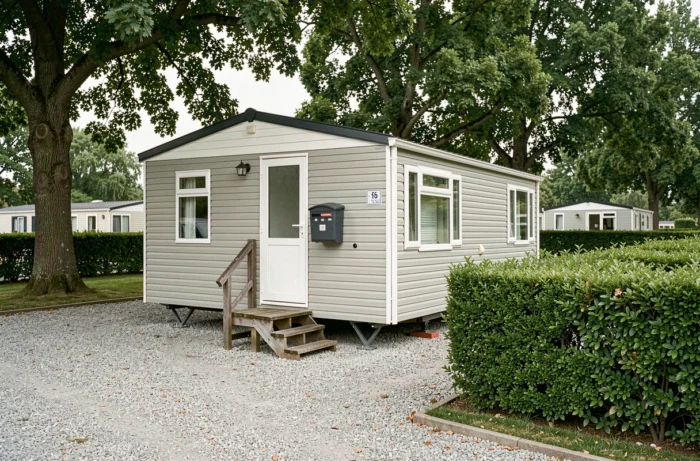
Election of residence via the CCAS: a right for mobile home residents
The election of residence mechanism provided for in article L.264-1 of the Code of Social Action and Families directly concerns individuals living in campsites, mobile homes, caravans, or any other mobile housing without a fixed address. The CCAS, CIAS, or an approved organization issues a certificate valid for one year, renewable by right.
Several points deserve attention:
- The CCAS must respond within a two-month period after the request. The absence of a response within this timeframe constitutes implicit acceptance.
- The residence does not depend on the legality of the mobile home’s installation concerning land use regulations. Even if the land is in a disputed zone, the right to an administrative address remains guaranteed.
- The certificate ends only if the person does not contact the domiciliation organization for more than three consecutive months.
This mechanism allows for the opening of civil rights (registration on electoral rolls, access to social benefits, receipt of administrative mail) without the need for a traditional lease or a dwelling recognized as housing under the Urban Planning Code.
Main residence in a mobile home: what tax case law says
The Court of Cassation provided notable clarification in a decision dated July 11, 2024. The ruling reminds us that, to qualify as a main residence, it is the effective occupation of the dwelling that takes precedence over the declared tax address. A taxpayer who is tax domiciled with a relative or through a domiciliation company may be requalified if the judge finds that they habitually reside in a campsite or mobile home.
However, this qualification has direct tax consequences. The mobile home occupied as a primary residence may be subject to residence tax on secondary residences if the administration does not recognize the status of main residence, or to other local taxes depending on the classification of the land.
Camping ground, PRL, or private plot: different urban planning regimes
The location of the mobile home determines the possibility of legally residing there year-round. The Urban Planning Code strictly regulates the installation of mobile leisure residences (RML).
- In a classified campsite, permanent residence is generally not allowed. Most campsites are designed for seasonal or leisure use, even those open year-round. Renting a plot for the year does not automatically confer the right to establish permanent residence.
- In a leisure residential park (PRL), the conditions are more favorable. Some PRLs allow year-round occupation, with adapted plot rental contracts. The PRL has a specific regulatory framework that allows, under certain conditions, to establish residence there.
- On a buildable private plot, the installation of a mobile home requires prior declaration or a building permit depending on the size. The plot must be serviced and located in an area where the local urban planning plan allows this type of housing.
- On agricultural or non-buildable land, installation for residential purposes is prohibited. Violations are subject to criminal penalties and restoration ordered by the court.

Local taxation and mobile homes: residence tax and tourist tax
The tax treatment of a mobile home varies depending on its use and location. The BOFiP (Official Bulletin of Public Finances) specifies the rules applicable to mobile leisure residences in several instructions.
A mobile home installed permanently on a plot, connected to networks, and losing its effective mobility may be considered a construction for tax purposes. In this case, property tax and residence tax (secondary residences) may apply.
For mobile homes located in campsites, a tourist tax is generally levied on temporary occupants. However, permanent residents are normally not subject to it, provided they can prove their primary occupation.
Gap between law and practice
The gap between these regimes creates ambiguous situations. A permanent resident in a campsite may find themselves liable for the tourist tax if the manager does not distinguish between permanent occupants and vacationers. Conversely, a mobile home declared as a secondary residence may be subject to increased taxation in high-demand areas.
The French framework thus allows for administrative domiciliation in campsites or mobile homes through the CCAS, regardless of the land status. Recognition as a main residence, however, relies on effective occupation verified by the tax administration or the judge. The main variable remains the land: its classification in urban planning determines whether permanent habitation is legal, tolerated, or punishable.