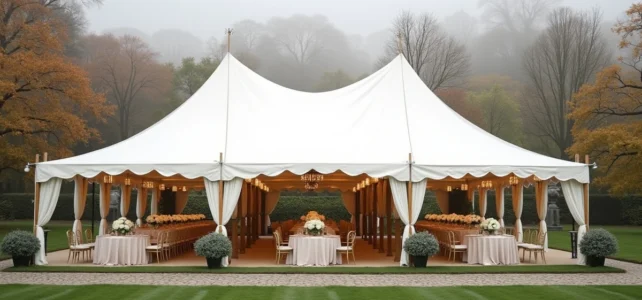
A wedding marquee is not chosen like a reception hall. The temporary structure imposes technical constraints that most mainstream providers do not detail: anchoring to the ground, wind resistance, thermal management, regulatory thresholds. We review the key points that make the difference between a well-managed reception and an improvised site.
Anchoring, waterproofing, and wind resistance: the technical triptych of a reliable wedding marquee
The strength of a marquee relies on three inseparable parameters. The anchoring to the ground determines the entire stability of the structure. On soft ground (lawn, compacted earth), driven stakes are usually sufficient. On concrete slabs, terraces, or parking lots, it is necessary to use concrete or steel weights, which increases logistics and setup costs.
Waterproofing is not just about a tarp placed over a frame. We recommend checking that the provider offers high-frequency welded fabrics with integrated gutters. A laced assembly or simple overlapping allows water to seep in as soon as the wind presses the fabric against the frame.
Regarding wind resistance, serious providers size their structures according to precise calculation standards. Demand a strength certificate or a calculation note. In Paris and the Île-de-France region, gusts during summer storms regularly exceed the thresholds that a standard market tent can withstand.
When considering wedding marquee rental in Paris, these three criteria must be included in the specifications before any discussion about decoration or interior layout.
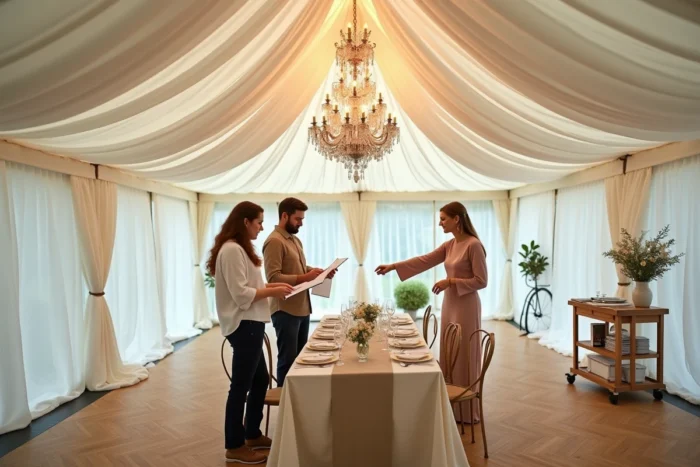
Thermal management of the marquee: heatwave and nighttime coolness
The heatwave has become a key design criterion for summer weddings in the Paris region. Recent recommendations include ventilation, shading, misters, and water points as budget items to be planned from the project phase, not as last-minute options.
A closed marquee without air circulation becomes a greenhouse beyond thirty degrees. We observe that structures with modular transparent side closures offer the best compromise: they protect from rain while allowing natural cross-ventilation when raised.
For weddings in the height of summer, plan a separate lounge area with air movers or mobile air conditioning. The cost of a dedicated climate control system is well justified against the risk of seeing your guests leave the reception tent mid-evening. However, for weddings in September or October, underfloor heating or forced air heating remains the norm in Île-de-France.
Regulatory thresholds and event safety in Paris
This is the point that most articles on wedding marquee rental overlook. Beyond certain attendance thresholds, safety obligations change radically. The thresholds of 300 and 1,500 people trigger distinct levels of preparation that impact the safety file, the on-site setup, and the overall budget.
For a classic Parisian wedding (between 80 and 250 guests), you remain below the first threshold, but this does not exempt you from formalities. The installation of a temporary structure on public land or in certain private spaces requires prior declaration at the town hall. In Paris, processing times vary by arrondissement.
Here are the elements to include in the safety file of a reception marquee:
- Scaled site plan with distances from neighboring buildings and fire access routes
- Wind resistance certificate and compliance certificate for the structure provided by the rental company
- Evacuation system: number and width of emergency exits, autonomous safety lighting, suitable fire extinguishers
- Temporary non-slip floor coverings if the ground poses a risk in case of rain
Never sign a rental contract without verifying that the provider supplies these documents. A rental company that does not offer a strength certificate or a standard safety plan likely does not have the appropriate insurance.
Surface area and configuration: sizing a marquee for a wedding reception
The necessary surface area depends on the reception format, not just the number of guests. A seated dinner with a dance floor requires significantly more square meters than a standing cocktail. The “seated meal” configuration consumes two to three times more space per person than a cocktail format.
We recommend thinking in terms of zones rather than overall surface area:
- Dining area: tables, chairs, circulation for service staff
- Dance and entertainment area: clear space, sound and lighting control
- Cocktail or reception area: often under a secondary structure like a pagoda
- Technical area: catering kitchen, service area, storage, generator
Setting up a large marquee requires heavy vehicle access and maneuvering space. In Île-de-France, some estates or private gardens impose access constraints that limit the maximum size of the structure. Check this point before signing with a reception venue.

Rental contract and insurance: clauses to check
The rental contract for an event marquee must explicitly mention the setup and dismantling service, installation deadlines, and cancellation conditions related to the weather. A contract without a weather clause is a warning sign.
Check that the provider has professional liability insurance covering damage to third parties throughout the duration of the event, including setup and dismantling. Your own home insurance generally does not cover temporary structures installed on your property.
Last point often overlooked: restoring the site after dismantling. The anchoring stakes leave holes, and repeated vehicle passage damages the lawn. A professional provider includes site restoration in their quote. Those who do not will leave you with an unmanageable garden on Monday morning.