On a swimming pool site, the bench is often decided last, once the excavation has begun. We then find ourselves fixing dimensions without having tested the actual position in the water. The result: a seat that is too high where the water reaches the knees, or too deep where one slides forward without back support.
The choice of dimensions for a swimming pool bench directly affects the daily comfort of the pool, much more than the coating or the color of the liner.
Sitting posture and position in the pool: two sizing logics
You don’t sit the same way on a bench placed at the end of the pool and on a bench that runs along a long side. This distinction, rarely made clear, changes all the dimensions.
On a bench at the end of the pool, one adopts a “lounge chair” posture: back inclined, legs extended forward. The seat width must be sufficient so that the ankles do not hang in the void. If the seat is too short, the lower back arches and relaxation disappears after a few minutes.
On a side bench (along the long side), one sits more “on a bench.” The feet naturally rest on the bottom of the pool, which changes the angle between the pelvis and knees. A narrower width remains comfortable because the body does not rest entirely on the seat. Understanding the dimensions of a swimming pool bench based on this target posture helps avoid unnecessarily oversizing one side of the pool.
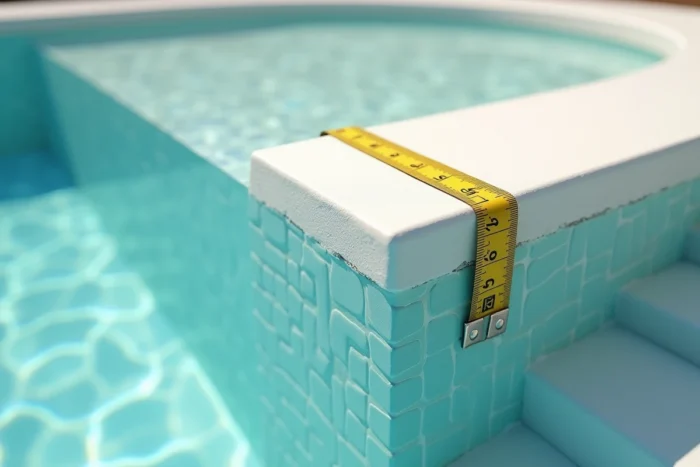
In summary, the width is not chosen “in absolute terms”: it depends on the intended use and the location in the pool.
Water height on the bench: the parameter most corrected by field feedback
The water height above the seat determines whether one feels immersed or simply wet. Too little water and you get cold as soon as the wind picks up. Too much water and children can no longer touch the bottom, which negates the safety interest of the bench.
The trap of a single measurement
A standard range for the water depth on the seat is often read. In practice, the ideal height depends on the size of the main users. A medium-sized adult sitting comfortably needs the water to reach between the lower chest and the middle of the belly. For a child, this same water height can reach the shoulders.
Feedback from pool forums shows that many owners would have preferred a bench slightly higher (thus less water on the seat) than what was initially planned. Feedback varies on this point, as it all depends on the installation and the profile of the swimmers, but the tendency to underestimate the seat height frequently recurs.
Connection with the overall depth of the pool
The bench creates a step in the pool. Its height conditions the useful swimming depth in the adjacent area. In a pool of modest dimensions, a bench that is too thick reduces the area where one can actually swim. It is recommended to draw a cross-section plan of the pool with the bench before finalizing the dimensions, to ensure that there is enough depth on the swimming side.
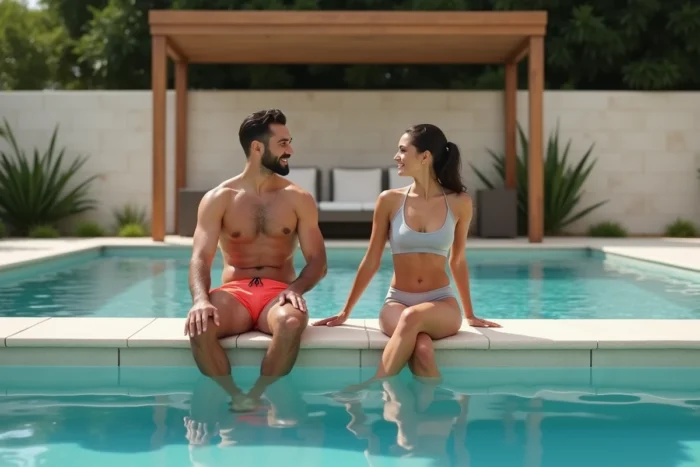
Swimming pool bench width: balancing comfort and swimming space
The width of the bench (the dimension on which one sits) is the most structuring parameter. It directly reduces the swimming surface.
- For a “bench” type seat along a wall, a moderate width is sufficient. One sits there to chat, supervise children, or take a break between laps.
- For a relaxation bench at the end of the pool, it is necessary to plan for a significantly wider space to stretch the legs without them extending into the swimming area.
- If massage jets or an aerotherapy system are to be installed, the width must also account for the necessary setback so that the jet properly reaches the back, not the lower back.
A bench that is too wide in a small pool turns the pool into a wading pool. In a pool less than eight meters long, every centimeter of bench costs swimming length. The decision is straightforward: first define the minimum desired swimming area, then allocate the rest to the bench.
Finishes and technical details that modify real comfort
The raw dimensions do not tell the whole story. Two benches of the same dimensions can offer very different comfort depending on the finishes.
- The rounding of the step edge changes the sensation under the thighs. A sharp angle becomes uncomfortable after twenty minutes. Polyester shells often include a standard rounding, but in sprayed concrete, it must be specified to the mason.
- The inclination of the backrest (when the bench is against the wall) is as important as the width. A strictly vertical wall forces one to sit up straight. A slight inclination of the backrest significantly improves comfort without changing the footprint.
- The non-slip coating on the seat prevents slipping forward, especially if the bench is wide and one is partially lying down on it.
These details are decided at the planning stage, not after pouring. Modifying a backrest inclination or a step edge rounding once the pool is built is costly and often impossible in a shell pool.
The sizing of a swimming pool bench comes down to three decisions made together: the position in the pool (end or side), the water height on the seat suitable for the users, and the width compatible with the remaining swimming space. Validating these three points on a cross-section plan before the construction remains the most reliable way to avoid regrets once the pool is filled.