
A Mediterranean lawn must withstand long, dry summers, ground temperatures regularly exceeding 35 °C, and soils that are often calcareous or highly draining. These three constraints immediately eliminate most blends sold in garden centers, which are designed for oceanic or semi-continental climates.
Choosing the right grass for a garden in the south of France involves understanding the difference between cool-season grasses and warm-season grasses, and then balancing winter aesthetics with summer water efficiency.
C3 and C4 Grasses: The Distinction That Determines Everything Else
Grasses are classified into two physiological categories based on their photosynthesis method. C3 grasses (perennial ryegrass, fescues, meadow grass) grow actively between 15 and 25 °C. They remain green in winter but suffer as soon as temperatures exceed 30 °C and water is scarce.
C4 grasses (Cynodon dactylon, Zoysia, Kikuyu, Paspalum) follow an inverse cycle. Their growth starts above 25 °C, they tolerate much higher temperatures, and their water needs are significantly lower. The downside: they yellow at the first cold spells and enter dormancy from November to March in the south of France.
Finding the best grass for a Mediterranean climate requires deciding between a green carpet all year round (C3, which is very water-intensive) and a grass that is frugal in summer but straw-colored in winter (C4). No blend perfectly combines both qualities, despite what some packaging may suggest.
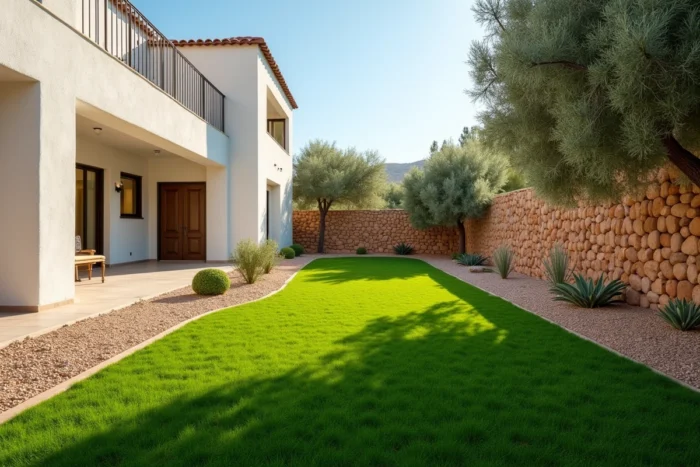
Hybrid Cynodon dactylon: The Most Water-Efficient Candidate
Among the C4 grasses suited to the Mediterranean climate, hybrid varieties of Cynodon dactylon (Bermuda grass) stand out for gardens subject to watering restrictions. Tests on drought-resistant lawns indicate a 60 to 70 % reduction in water consumption compared to a standard C3 lawn.
A hybrid like Cynodon dactylon “IBIZA” remains green with just one weekly watering in the height of summer, whereas a classic ryegrass/fescue blend requires three to four. On a calcareous or sandy soil typical of the Mediterranean coast, this difference translates to hundreds of liters saved each week for an average lawn area.
Limitations to Know Before Seeding
- Cynodon is spreading and easily colonizes neighboring beds if not contained by a border. Plan for a physical barrier buried at least 15 cm deep.
- Its winter yellowing lasts four to five months in the Provençal hinterland. The aesthetic result displeases those expecting green grass twelve months a year.
- Establishment by seeding is slow: the lawn does not fully cover the ground for several months. The roll-out alternative speeds up the result, but the cost per square meter is significantly higher.
Tall Fescues and Resilient Blends: The Four-Season Compromise
For those who cannot tolerate straw-colored grass in winter, deep-rooted tall fescues offer the best compromise within the C3 family. Their root system goes much deeper than that of ryegrass, allowing them to capture residual soil moisture during dry periods.
So-called “innovative” blends combine tall fescue and micro-clover (or specific Water Saver varieties). These combinations reduce watering needs by up to 40 % compared to a standard lawn while providing better recovery capacity after water stress.
Tall Fescue or Cynodon: Comparative Table
| Criterion | Hybrid Cynodon dactylon (C4) | Tall Fescue (C3) |
|---|---|---|
| Water savings vs. standard lawn | 60 to 70 % | Up to 40 % (in resilient blend) |
| Winter appearance | Yellow/straw (dormancy) | Green all year round |
| Resistance to trampling | Very high | Good |
| Calcareous/draining soil | Very suitable | Suitable (dryland varieties) |
| Installation speed | Slow (seeding) / fast (roll-out) | Medium |
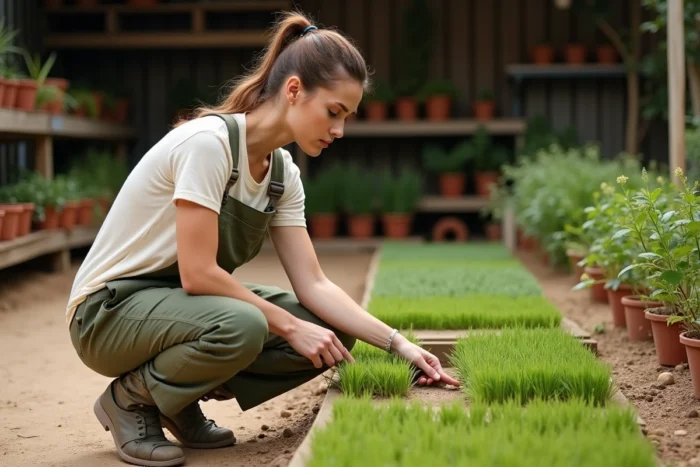
Water Restrictions and Drought Decrees: A Determining Choice Criterion
Since 2022-2023, drought decrees have multiplied in the French Mediterranean regions. Under heightened alert, lawn watering is prohibited or limited to restricted nighttime slots. A classic C3 lawn does not survive these periods without regular watering.
This regulatory constraint changes the game. Choosing a hybrid Cynodon or a tall fescue/micro-clover blend is no longer just a comfort choice: it is a condition for maintaining a functional lawn when restrictions apply.
Specialized “dryland without irrigation” blends incorporate selected tall fescues for very draining soils. On calcareous land in Var or Bouches-du-Rhône, these seeds provide an acceptable result without supplemental irrigation once the lawn is well-rooted, provided one accepts partial yellowing in August.
Seeding or Roll-Out Grass: Which Establishment Method in Dry Climate
The choice between seeding and roll-out depends as much on budget as on planting season. In the Mediterranean zone, C4 grass seeding must be done in spring, when soil temperatures exceed 20 °C. An autumn seeding, common for C3, would fail due to insufficient heat for germination.
Roll-out grass has a decisive advantage in the south: immediate ground coverage limits erosion and evaporation. The root system anchors within weeks if installation watering is respected. The cost remains higher, but the risk decreases significantly compared to a seeding exposed to an early heatwave.
- For C4 seeding, plan for a period of three to four months before complete coverage. Keep the surface soil moist during germination.
- For a roll-out of Cynodon or Zoysia, schedule installation between April and June. Water daily for the first two weeks, then space out gradually.
- For tall fescue seeding, prefer September-October: autumn rains facilitate rooting before the first summer.
The Mediterranean lawn is primarily chosen for its physiology (C3 or C4), then for its suitability to the soil and local water restrictions. A hybrid Cynodon remains the most water-efficient solution for a southern garden, while a blend of tall fescues offers the best aesthetic compromise year-round. Soil preparation remains the same in both cases: a decompacted, leveled, and amended soil is much more crucial to success than the choice of variety alone.