
Buying auto parts online to maintain your vehicle involves navigating between various types of products, differing quality levels, and compatibility constraints specific to each model. The price difference between an original manufacturer part and an aftermarket part can reach a factor of two or three for some common references. Understanding what justifies these discrepancies, and especially what does not, allows for making informed purchasing decisions based on measurable criteria.
Reused auto parts: what regulations require since 2024
The AGEC law and its decrees from July 2024 have extended the obligation to offer circular economy parts (PIEC) to two- and three-wheeled motorized vehicles, in addition to cars. Professionals must now retain proof of the information provided to the customer about these reused parts for two years.
Failure to comply with this obligation can result in fines of up to 3,000 euros for individuals and 15,000 euros for companies. This regulatory constraint has pushed online platforms to structure their catalogs to clearly distinguish between new, refurbished, and reused parts.
A point often overlooked concerns safety parts. Since August 2026, eBay has announced a ban on the sale of airbags (including inflators and covers) on its platform. In France, the resale of airbags by individuals was already prohibited: only authorized professionals can offer these parts.
Before ordering a part related to passive safety, checking the seller’s status is a precaution that is both common sense and legally required.
The catalogs available on carburauto.fr allow filtering references by vehicle and category, making it easier to locate parts compatible with a specific model.
Original, OEM, or aftermarket parts: a comparative table of differences
The terms used by online sellers do not all cover the same technical reality. Here is a comparison of the three main categories of parts available on the market.
| Type of part | Manufacturer | Marking | Price level | Typical warranty |
|---|---|---|---|---|
| Original part (OE) | Automotive manufacturer | Manufacturer logo + reference | Highest | Manufacturer warranty (often 2 years) |
| OEM part (equipment manufacturer) | Subcontractor of the manufacturer | Equipment manufacturer reference, no manufacturer logo | Intermediate | Variable depending on the manufacturer (1 to 2 years) |
| Aftermarket part | Independent third-party manufacturer | Own reference, announced compatibility | Lowest | Variable (6 months to 2 years) |
The OEM part is manufactured by the same equipment manufacturer as the original part but sold without the manufacturer’s logo. The product is technically identical in most cases. The price difference between an OE part and its OEM equivalent is mainly explained by the manufacturer’s network margin and brand cost.
In contrast, an aftermarket part is not manufactured by the same equipment manufacturer. Its quality entirely depends on the third-party manufacturer. Some produce reliable parts, while others do not. A low price does not automatically mean insufficient quality, but the lack of traceability to a known equipment manufacturer increases the risk.
OEM reference and chassis number: the two checks that avoid returns
The primary cause of returns on online auto parts platforms remains incompatibility. Two vehicles of the same model and year may use different parts depending on the engine, trim, or place of manufacture.
- The OEM reference (engraved or printed on the original part) is the most reliable way to identify the correct product. It allows for exact matching in the platforms’ databases.
- The chassis number (VIN), composed of 17 characters, uniquely identifies the vehicle. VIN search tools automatically cross-reference the model, engine, and year to filter compatible parts.
- The registration number provides access to the information on the registration document but is less precise than the VIN for imported vehicles or special series.
For body parts (bumpers, wings, mirrors), compatibility also depends on the presence of sensors (rear radar, camera) or equipment specific to a trim. A bumper designed for a model without radar will not accommodate the sensors from an equipped version, even if the exterior shape appears identical.
Filters, brakes, timing belts: balancing cost and durability
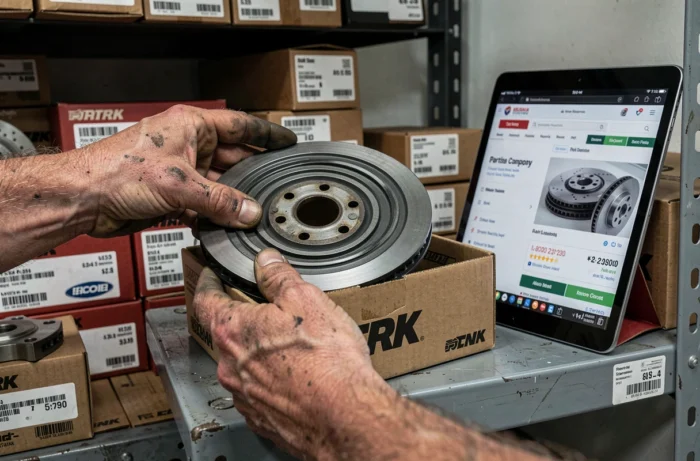
Not all parts warrant the same level of investment. For an oil filter or an air filter, the performance difference between an OEM part and a recognized brand aftermarket part remains marginal for regular use. These wear parts are replaced at regular intervals, and their unit cost remains moderate.
Conversely, for a timing belt kit, brake pads, or a clutch, prioritizing an OEM part reduces the risk of premature failure. The cost of an early replacement (including labor) far exceeds the savings made at purchase.
For vehicles over ten years old, a study reported by AM Today indicates that the vast majority of owners are willing to consider a used part. Reuse makes perfect sense for robust mechanical components (alternator, starter, gearbox) whose lifespan often exceeds that of the original vehicle.
Warranty and return conditions
Checking the warranty duration before purchase remains an underestimated reflex. An aftermarket part guaranteed for six months costs less at purchase, but a replacement in the seventh month nullifies any savings. Reputable platforms clearly display the return policy and coverage duration for each reference.
Choosing an auto part online boils down to three concrete checks: the OEM reference for compatibility, the type of manufacturer (OE, OEM, or aftermarket) for quality level, and the warranty duration for coverage in case of defects. For safety parts, French regulations now require going through authorized professionals, which limits options but protects the buyer.