
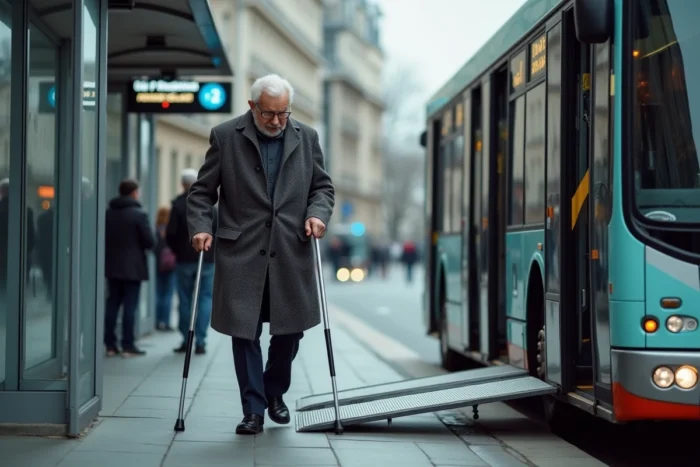
The acronym PMR refers to any person hindered in their movements, whether the cause is a permanent disability, a temporary injury, age, pregnancy, or simply pushing a stroller. This category far exceeds the scope of wheelchairs and encompasses situations that most passersby experience at least once in their lives.
Legal criteria that define reduced mobility in France
French regulations do not provide a closed list of pathologies. Instead, they focus on functional criteria: walking perimeter, use of technical or human assistance, and expected duration of the impairment. A recent ruling from the administrative court of Melun reminds us that difficulties must be permanent or last at least one year to open certain rights, even when the pathology is progressive.
Specifically, the following situations fall within the scope of reduced mobility:
- A walking perimeter of less than 200 meters, with or without technical assistance (cane, walker, wheelchair).
- The systematic use of portable oxygen therapy or human assistance to move around.
- A sensory impairment (blindness, profound deafness) or cognitive issues that complicate orientation in public spaces.
- A temporary situation such as a fracture, advanced pregnancy, or transporting a child in a stroller.
This functional approach explains why PMR and disability are not synonymous. An elderly person slowed down by arthritis or a traveler burdened with heavy luggage falls into the PMR category without being classified under the disability recognized by the MDPH. Understanding the definition of reduced mobility in its functional dimension helps to grasp why accessibility obligations concern a much broader audience than one might imagine.
Mobility precariousness: the socio-economic factor that the classic definition ignores
Typical content about PMR stops at physical or sensory disabilities. The 2024 Daily Mobility Barometer, published by Wimoov and its partners, broadens the scope: 15 million French adults live in a situation of mobility precariousness, up from 13.3 million in the previous edition.
Nearly one in three French people does not have the freedom to choose their mode of transportation. The combination of low income, high transport costs, significant distances, and lack of alternatives to the car creates a form of reduced mobility that has nothing to do with a pathology.
This shift is significant. It means that a valid person living in a rural area without a driver’s license faces daily movement restrictions comparable to those of a person in a wheelchair at an inaccessible train station. Public policies are beginning to integrate this reality through the concept of solidarity mobility, notably described by the Paris Region Institute, which aims for mobility autonomy as a lever for professional and social integration.
Accessibility of public spaces and transport: where are the developments
The law requires establishments open to the public (ERP) to ensure access for people with reduced mobility. The obligations concern access ramps, door widths, appropriate signage, tactile guiding strips, and reserved parking.
In transport, the situation remains mixed. An article from Le Monde in July 2026 documents a series of failures in the care of PMR at Parisian airports, where passengers describe being “treated like luggage.” This type of testimony illustrates the persistent gap between the regulatory framework and lived experience.
Active mobilities and PMR: an underestimated angle
The Ministry of Ecological Transition reminds us that active mobilities directly concern people with reduced mobility. Walking and adapted cycling sometimes constitute the only alternative in the face of public transport inaccessibility. Subsidies exist for the purchase of adapted bicycles (handbikes, electric-assist tricycles), and route calculators like Handimap incorporate urban obstacles and specific PMR or senior profiles.
The development of accessible cycling facilities, with gentle slopes and smooth surfaces, benefits all users. A lowered curb for a wheelchair also serves a parent with a stroller, a delivery person with a cart, and an elderly pedestrian.

Inclusion mobility card: the document that materializes rights
The inclusion mobility card (CMI) has replaced the old disability and parking cards for several years. It has three possible mentions: disability, priority, and parking. Each mention opens distinct rights.
- The mention “disability” grants access to tax benefits and priority in queues and transport.
- The mention “priority” is for people whose disability rate is below the threshold required for disability but who experience difficulty standing.
- The mention “parking” allows the use of reserved spaces on the road and in public parking lots, free of charge and without time limit.
The application is made through the MDPH or, for war veterans, through the departmental service of the ONACVG. The processing time varies by department, but the CMI in credit card format, secured by a QR code, has simplified the process compared to the old paper formats.
The French framework for reduced mobility goes beyond the question of disability to encompass social, economic, and demographic realities. With the aging population and the documented increase in mobility precariousness, developments designed for PMR benefit an increasing portion of the population.