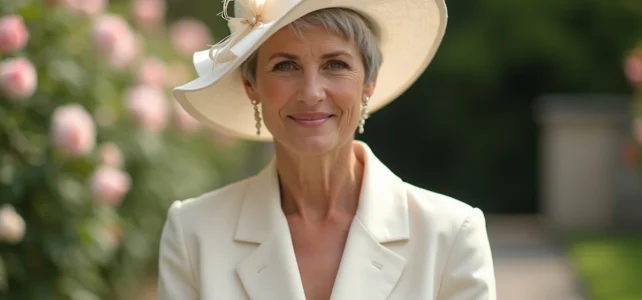
An impeccable pixie cut, a tailored suit, and that fascinator that seemed perfect in the shop slips to the side with the first gust of wind. The problem isn’t the hat or the cut: it’s how the hair is prepared beforehand and the choice of style in relation to the shape of the face.
With short hair after 50, there’s a real advantage: a completely exposed face that captures light and highlights the structure of the hat.
Securing the hat on short hair: the issue that no one addresses in the shop
On long hair, a hat stays in place thanks to volume and the natural friction of the strands. On a short cut, this grip disappears. You find yourself adjusting the fascinator every ten minutes during the ceremony, which ruins both the look and comfort.
The most reliable solution remains hat combs sewn inside the headpiece. Most milliners offer this service, and you can also do it yourself with a small metal comb attached with a few sturdy stitches on the inner ribbon. You slide the comb into the hair at the temple, and the hat stays put.
Another option for very short cuts (buzz cut or undercut): a thin elastic headband sewn into the lining, which wraps around the head without being visible. To find the right model suited to one’s morphology, the choice of a wedding hat for short hair after 50 relies as much on the securing system as on aesthetics.
One last often-overlooked point: hairspray. A light dry hairspray is sprayed on contact areas (temples, back of the ears) before placing the hat. The matte texture creates micro-adhesion that stabilizes everything without stiffening the hairstyle.
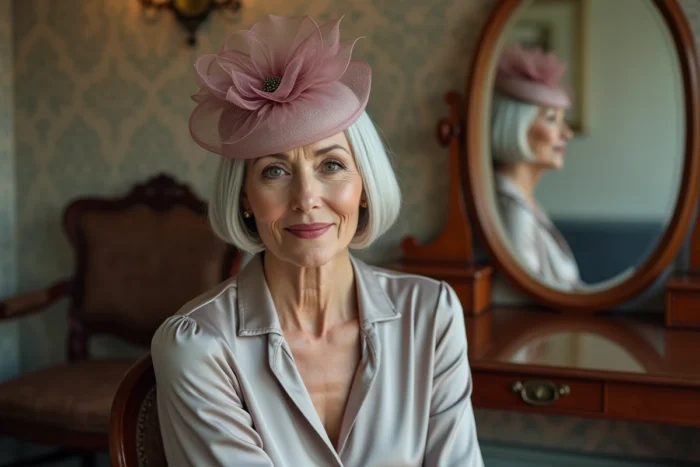
Face shape and ceremony hat: combinations that work after 50
The common reflex is to choose a “pretty” hat without considering the geometry of the face. With short hair, this mistake is immediately noticeable because no strand corrects the proportions.
Round or full face
Avoid bells and toques that hug the skull and accentuate roundness. An asymmetrical brim hat or a high-crowned fedora visually elongates the face. The 2025 trends confirm this direction with clean lines and structured brims that create verticality.
Long or rectangular face
The goal reverses: we seek to break the length. Wide-brimmed sun hats and fascinators worn to the side work well. The hat is worn slightly tilted back to expose the forehead without adding height.
Oval face
Most shapes are suitable. One can afford a sculptural fascinator, a fascinator with a veil, or a boater. The freedom is greater, so choices are made based on the outfit rather than morphology.
- Round face: high-crowned fedora, hat with one side upturned, vertical fascinator
- Long face: wide-brimmed sun hat, fascinator worn low to the side, flat toque
- Square face: rounded shapes (soft bell, women’s bowler) that soften the jawline angles
- Oval face: almost all models, with a preference for structured pieces that enhance natural balance
Texture and styling of short hair under a wedding hat
A stunning hat placed on flat, dull hair produces a disappointing result. Pre-hat styling makes all the difference, especially on gray or salt-and-pepper hair that tends to lack shine.
Ultra-shiny Hollywood-style straightening works remarkably well on short gray hair. Apply a thermo-protective serum, straighten strand by strand with a flat iron, then set with a shine spray. The result is sleek, luminous, and provides the hat with a flawless base.
For those who prefer volume, a styling mousse applied to damp hair and dried upside down creates an airy texture. Then, work a few strands with a curling iron to add movement around the ears and nape, the visible areas under the hat.
Opinions vary on the use of texturizing wax: some hairstylists recommend it to create an “effortless” effect on a pixie, while others believe it weighs down fine hair. On thick hair, a dab of wax on the tips gives a nice sculptural effect. On fine hair, a dry texturizing spray is preferred.
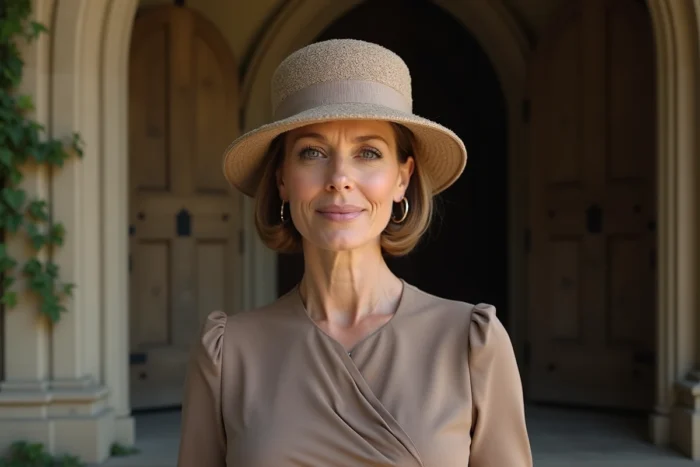
Hat color and harmony with gray or colored hair
The choice of hat color directly depends on the hair shade, and after 50, we often work with shades of gray, white, or colorations that evolve towards softer tones.
Gray or white hair can support bold colors that brunettes or blondes may not always wear. A burgundy, deep navy blue, or emerald hat creates a striking contrast with silver hair. Pastel tones (powder pink, lavender) also work, but there’s a risk of a too-uniform effect if the skin is very light.
- Silver gray hair: navy blue, burgundy, forest green, black with contrasting detail
- Salt-and-pepper hair: camel, taupe, plum, navy
- Bright white hair: vibrant colors (red, cobalt), or nude pink for a tonal effect
- Honey or golden balayage: warm tones (terracotta, champagne, aged gold)
Avoid beige on ash blonde hair: everything blends and the hat disappears. The ceremony hat should create a dialogue with the hair color, not blend in with it.
The material is as important as the shade. Natural sisal or braided straw is suitable for spring and summer weddings. Fine felt or velvet is essential for autumn and winter ceremonies, with the advantage of adding visual depth to a short cut.
The final detail that changes everything: matching the veil or ribbon of the hat to an element of the outfit (earrings, bag, shoes) rather than to the dress itself. This coherence through accessories gives a polished look without apparent effort, exactly what we seek for a ceremony.