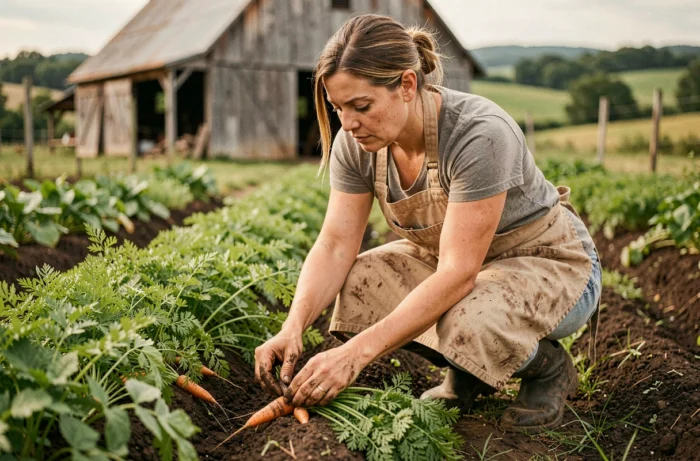
Measuring the real impact of local agriculture on food sustainability requires comparing concrete data: carbon footprint of transport, nutritional quality, remuneration of producers, regulatory framework. Local agriculture promises more sustainable food, but the gaps between short supply chains and long supply chains vary according to the indicators used.
Short supply chains and long supply chains: measurable gaps in food sustainability
The debate on local agriculture often boils down to the question of transport. The reality is more nuanced: the production phase accounts for the majority of the environmental footprint of a food item, far ahead of logistics.
| Criterion | Local short supply chain | Conventional long supply chain |
|---|---|---|
| Average distance traveled | Less than 150 km (often less than 80 km) | Several hundred to thousands of km |
| Intermediaries between producer and consumer | 0 to 1 | 3 to 6 |
| Share of value captured by the farmer | Significantly higher | Reduced fraction of the final price |
| Traceability for the consumer | Direct (name, location, method) | Opaque without specific label |
| Seasonality respected | Generally yes | Variable, often circumvented |
This table highlights a point often underestimated: farmers’ remuneration significantly increases in short supply chains. Fewer intermediaries mean that the price paid by the consumer finances production work more than logistics or distribution margins.
The levers and challenges connecting local agriculture and sustainable food go beyond just the logistical question, as one can learn more on the Aline Archimbaud website through an analysis of the social and environmental dimensions of these supply chains.
Collective catering: the regulatory framework pushing towards local
Collective catering is a structuring lever to direct demand towards local and sustainable products. The French framework has recently evolved in this direction.
The “my canteen” tele-declaration now includes the origin from France and the European Union of the products purchased, with a fine distinction between national and European provenance. This update, effective since August 2026, allows for more precise tracking than the simple organic/non-organic binary that prevailed before.
One point deserves attention: the definition of “local” remains at the discretion of collective catering managers. No national standard sets a specific kilometer radius. A manager in Brittany and another in Île-de-France may qualify very different areas as “local,” complicating comparisons from one territory to another.
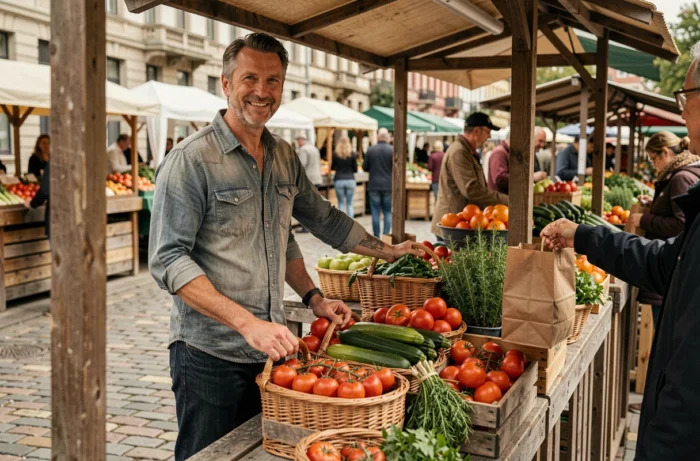
End of level 2 environmental certification
The consideration of level 2 environmental certification farms in public sustainable purchasing objectives must end by December 31, 2026. In practical terms, suppliers to collective catering will need to reach level 3 (High Environmental Value) or turn to organic to remain eligible.
This tightening pushes farmers towards more demanding agroecological practices. Farms in transition to organic agriculture remain valued in public objectives, which keeps a gateway open for producers in transition.
Agroecology and climate adaptation: what field data reveals
Local agriculture is not just about shortening distances. It is part of a transformation of production practices, especially in the face of climate change.
Several signals converge on the French ground:
- The diversification of crops is gaining ground, with the emergence of unusual productions in our latitudes (guavas, papayas, sorghum) in response to climate disruption, according to Les Echos.
- Agroecological practices (soil cover, long rotation, agroforestry) are identified as a lever for adapting to climate change, not just mitigation.
- Water management is becoming a major limiting factor: irrigation alone is no longer sufficient, and some specialists recommend changing cultivated species rather than maintaining historical crops with excessive water use.
Climate change is already reshaping the French agricultural map. Productions once confined to the tropics are settling in the south of the country, while traditional crops are declining. For the consumer, this means that the “local” of tomorrow will not resemble that of today.
Territorial food projects: a growing network
Territorial Food Projects (PAT) structure the meeting between local production and nearby demand. These initiatives, led by local authorities, aim to coordinate actors in a territory around common objectives: supplying canteens, maintaining agricultural land, supporting installations.
Their effectiveness heavily depends on local political will and the ability to unite producers, processors, and distributors within a coherent perimeter. Results vary from one territory to another, making national assessments difficult to establish.

Limits and blind spots of the all-local
Reducing food sustainability to the sole criterion of geographical proximity would be an analytical error. A local product grown in a gas-heated greenhouse may have a higher carbon footprint than an imported product grown in an open field.
Seasonality matters as much as distance. Buying local while respecting the harvest calendar divides the environmental impact much more clearly than merely reducing the kilometers traveled.
On the other hand, local agriculture has a structural advantage in the resilience of food systems. Short and diversified supply chains are more resistant to logistical disruptions than globalized chains dependent on a few transport corridors.
The shift towards more sustainable food relies on the combination of several factors: proximity, seasonality, agroecological practices, and fair remuneration of producers. Recent regulatory data shows that the French framework is gradually tightening to steer collective catering in this direction. The elimination of level 2 environmental certification by the end of 2026 represents the next concrete milestone in this trajectory.