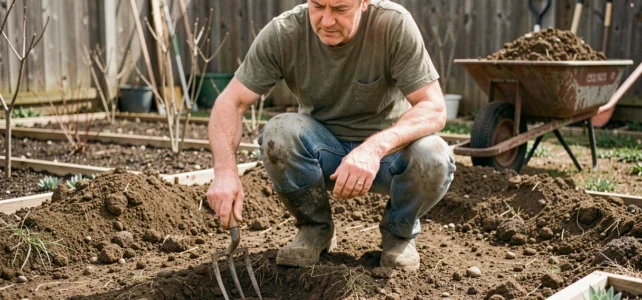
A failed grass seeding is rarely determined at the time of sowing. It is determined in the weeks leading up to it, when the soil is prepared. The physical structure of the substrate, its chemical balance, and its water retention capacity directly influence the germination rate and the density of the future cover. Here, we detail the technical points that make the difference between sparse grass and a homogeneous lawn from the very first shoots.
Soil Diagnosis Before Ground Work: Granulometry and pH
Before any digging, a soil diagnosis guides every decision. The texture (clay, loamy, sandy) determines the working depth, the type of amendment, and the intervention schedule. A compact clay soil requires deeper plowing and the addition of coarse sand to break up the structure. A sandy soil, on the other hand, needs organic matter to improve water retention.
The ideal pH for most grass species is slightly acidic to neutral. A soil that is too acidic requires corrective liming several weeks before sowing. An alkaline soil requires the addition of sulfur or peat. Without prior soil analysis, any amendment is a gamble.
We recommend at least a pH analysis kit, or better, a complete granulometric analysis in a laboratory. This diagnosis avoids blind corrections and allows for precise dosing of amendments.
Weeding and Exposing the Seedbed Surface
Exposing the ground is the first physical intervention. Any existing vegetation (weeds, wild grasses, mosses) competes directly with young grass seedlings for light, water, and nutrients. It must be completely eliminated.
For small areas, manual weeding by root pulling remains the most reliable method. On larger plots, using a tiller or rotary hoe can scalp the existing vegetation and bury it superficially. Before preparing the soil for grass, a rest period after weeding is necessary to allow the plant residues to partially decompose and avoid nitrogen hunger phenomena.
Case of Soils Overrun by Creeping Perennials
Couch grass, bindweed, horsetail: these rhizomatous weeds require specific treatment. Simple plowing fragments them and multiplies the points of regrowth. We observe better results with repeated false sowing (soil preparation, waiting for weed emergence, mechanical destruction) over two to three cycles before the final sowing. False sowing significantly reduces the pressure from perennial weeds.
Deep Soil Work and Seedbed Structure
Deep plowing or digging aims to loosen the soil to a sufficient depth to allow grass rooting. The working depth directly depends on the texture identified during the diagnosis.
- Heavy clay soil: plowing with a spade or tiller to at least two spade depths, followed by the addition of coarse sand and well-matured compost to lighten the structure
- Compact loamy soil: moderate deep work, incorporating coarse organic matter (young compost, wood chips) to limit the formation of crusting after the first rains
- Filtering sandy soil: generous incorporation of well-matured compost or well-decomposed manure to increase water retention capacity and substrate cohesion
After plowing, the soil should rest for a few days to settle naturally. Freshly turned soil that is too loose causes excessive sinking of seeds and irregular emergence.
Refining and Preparing the Seedbed
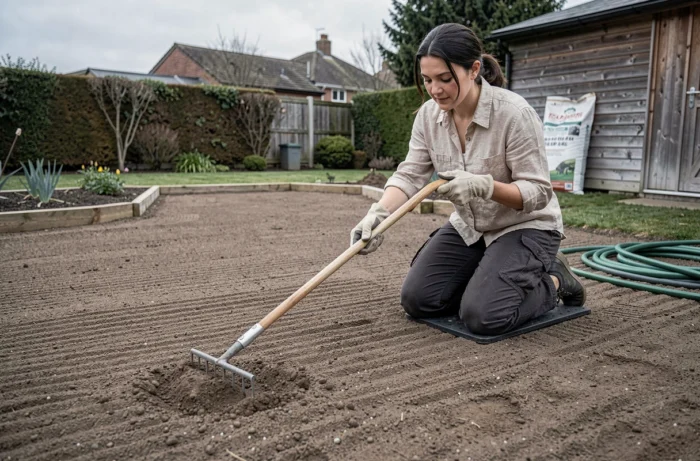
The refining step transforms coarsely plowed soil into a seedbed suitable for receiving seeds. Using a harrow or rake breaks up residual clods and creates a fine surface structure over a few centimeters. The surface granulometry must remain heterogeneous: overly pulverized soil forms an impermeable crust upon the first watering.
The classic trap is to refine too much. We prefer to keep aggregates the size of a hazelnut on the surface. They protect the seeds from runoff and maintain micro-pockets of air favorable to germination.
Organic Amendment and Regulatory Anticipation on Fertilizers
Base fertilization occurs before sowing, not after. The goal is to enrich the soil with phosphorus and potassium to support initial rooting, not leaf growth. An excess of nitrogen at sowing favors weeds at the expense of grasses.
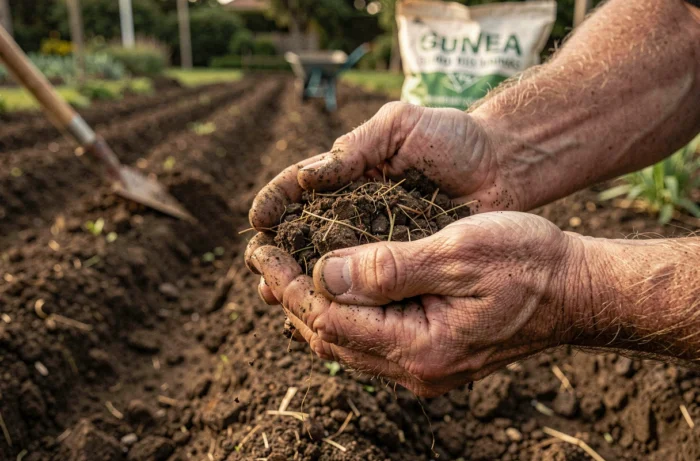
Well-matured compost remains the reference amendment. Incorporated during plowing, it simultaneously improves the structure, biological life, and fertility of the soil. Manures must be well-decomposed to avoid root burns and weed seeds.
Scheduled End of Synthetic Fertilizers for Individuals
Since the summer of 2026, regulatory syntheses remind us that synthetic fertilizers will be banned for non-agricultural uses by January 1, 2027, as part of the Climate and Resilience Law. For soil preparation before grass sowing, this means that synthetic starter NPK fertilizers, still widely sold in garden centers, will no longer be a legal option.
We recommend adopting an exclusively organic or organo-mineral fertilization approach now. This transition requires working on soil life upstream: regular additions of organic matter, limiting repeated deep work that destroys soil fauna, and maintaining plant cover between interventions.
Leveling and Rolling Before Grass Seeding
Leveling corrects dips and bumps that could cause stagnant water accumulations (seed rotting zones) or dry raised areas. A long-handled rake, pulled in cross passes, is sufficient for modest surfaces.
Pre-sowing rolling ensures uniform seed-soil contact across the entire surface. A moderately weighted garden roller, passed in two perpendicular directions, compresses the soil without excessively compacting it. The validation test is simple: when walking on the rolled soil, the shoe print should not sink more than one centimeter.
- Level with a rake in cross passes to eliminate undulations
- Roll once perpendicularly to the direction of future sowing
- Check for the absence of puddles after light watering: any retention area must be corrected before sowing
The ground is ready when the surface is flat, firm underfoot, finely crumbly on the surface, and moist without being waterlogged. It is this window of conditions that guarantees rapid and even germination of grass seeds.