
Sacha is a Russian hypocoristic derived from Alexander, formed by the Slavic diminutive suffix -sha applied to the root Alek-. The name dates back to ancient Greek Alexandros, composed of alexein (to repel, to protect) and andros (man), which gives it the meaning of protector of men. This direct linguistic lineage with Alexander explains why Sacha functions in Russia as an affectionate diminutive, just like Micha for Mikhail or Gricha for Grigori.
Slavic Morphology and the Derivation of the Name Sacha
The formation of Sacha follows a precise morphological pattern in the Russian system of diminutives. The name Alexander (Aleksandr in Russian) first goes through the short form Sacha, then can generate additional hypocoristics: Sachenka (affectionate), Sachka (familiar), Sachoura (archaic). This cascading derivation system is typical of Eastern Slavic onomastics.
We observe that French speakers often overlook that Sacha does not have the status of an official name in Russia. It appears on civil status documents in its full form Aleksandr or Aleksandra. It is everyday and literary usage that has ultimately allowed Sacha to function as a standalone name outside the Russian-speaking area.
A detailed article discusses the origin of the name Sacha on Ma Vie de Famille and traces this transition from diminutive to autonomous name as it has established itself in France.
Sacha as a Male Name in France, Mixed Elsewhere: A Sociological Gap
The French civil registry accepts Sacha for both genders, technically making it a unisex name. In practice, Sacha is predominantly given to boys, with a minority female usage slightly declining in recent years.
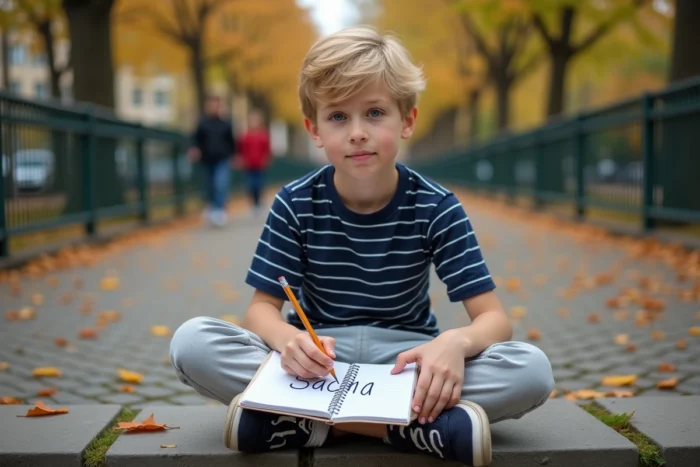
In English-speaking countries, the spelling Sasha leans distinctly towards the feminine. In the United States and the United Kingdom, Sasha is perceived as a girl’s name, particularly since it has been popularized by female personalities. In Germany, the spelling Sascha remains masculine, mirroring the original Russian usage.
This perception gap creates real situations for bilingual or expatriate families. A boy named Sacha in France may sometimes be mistaken for a girl in an English-speaking context. Franco-American or Franco-British families need to take this into account, which goes beyond the simple etymological question.
International Spellings and Variants
- Sacha (France, French-speaking Switzerland): French form, predominantly masculine in actual usage
- Sasha (English-speaking world): perceived as feminine in the United States and the United Kingdom, mixed in Canada
- Sascha (Germany, Austria): Germanic spelling, primarily masculine usage
- Saša (Serbia, Croatia, Slovenia): spelling with caron, common diminutive for both genders
Popularity of the Name Sacha in France: The Stabilization Phase
After a rise in popularity in the 2000s, the name Sacha has stabilized at a very high level in the ranking of male names, around rank 14 for boys and 19 overall, according to data from Journal des Femmes updated in 2024.
This stabilization distinguishes Sacha from trendy names, which experience a sharp peak followed by a rapid decline. The name has reached a sustainable plateau, suggesting that it has settled into the common repertoire of French names rather than being a passing trend.
Factors for the Name’s Resilience
Several characteristics explain this atypical longevity:
- The brevity (two syllables, five letters) makes it easy to pronounce in most European languages
- Its etymological connection to Alexander gives it a historical depth that invented names lack
- The final -a sound, common in French feminine names, gives it a phonetic softness that appeals to parents looking for an unconventional name for a boy
We recommend not to confuse this stability with a decline. A name that remains in the top twenty of the national ranking for several consecutive years remains a very popular choice.
Sacha in Russian Literature and Culture: Beyond a Simple Diminutive
The name carries a dense cultural weight in the Russian literary tradition. Alexander Pushkin, a founding figure of Russian literature, was called Sacha in his intimate circle. The diminutive signaled affectionate familiarity, not a devaluation of the official name.
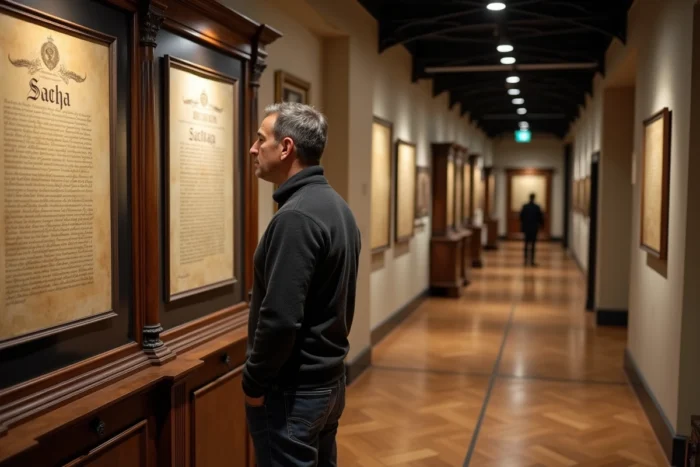
This relationship between civil status name and everyday diminutive structures social relations in Russia in a way that has no direct equivalent in France. Calling someone by their diminutive without permission constitutes a social transgression. The transition from Aleksandr to Sacha marks a precise relational boundary.
In France, this dimension has been erased. Sacha functions as a complete name, without hierarchical background. This semantic shift, from intimate diminutive to autonomous name, illustrates how a linguistic borrowing transforms as it crosses cultural boundaries.
Choosing Sacha: Parameters Not Addressed by Name Sheets
The question of administrative gender neutrality remains the most underestimated point. In France, the civil registry accepts Sacha for both genders without restriction. No spelling removes the gender ambiguity in writing, unlike names like Dominique (where usage is well established on both sides) or Camille (where the distribution is historically documented).
Parents choosing Sacha for a boy should anticipate that some administrative forms, school management software, or official correspondence may default it to the female gender. This is not a major obstacle, but it is a concrete parameter that name sheets focused on numerology or associated colors never mention.
The name Sacha has undergone a remarkable linguistic journey, from a Slavic diminutive reserved for the private sphere to a standalone name firmly established in the French repertoire. Its maintenance in the top ranks of the national ranking for several consecutive years confirms this lasting implantation.