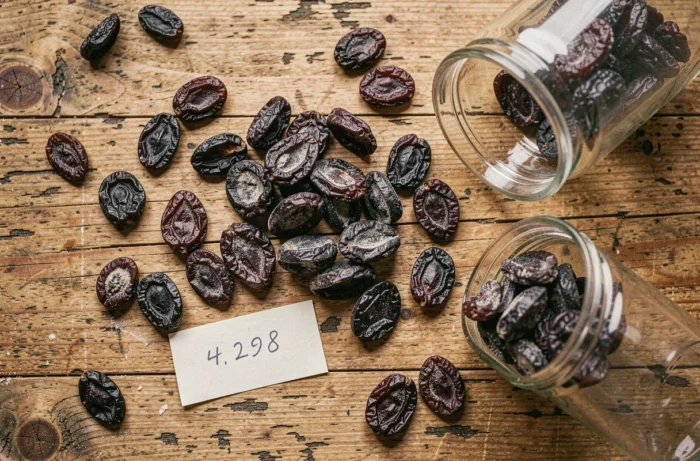
Prunes have a minimum durability date (MDD), not a use-by date (UBD). This distinction radically changes the risk analysis. A prune that exceeds its MDD is not a dangerous product by default; it is a product for which the manufacturer no longer guarantees the appropriate organoleptic qualities.
Water activity and microbiological stability of prunes
Consumer articles focus on the presence or absence of mold. We recommend reasoning instead in terms of water activity (Aw), the parameter that truly determines the microbiological stability of a dried fruit.
A properly dried prune has a sufficiently low Aw to inhibit the proliferation of most pathogenic bacteria. It is precisely this low water content that justifies classifying the product under MDD rather than under UBD.
The risk does not come from the calendar but from moisture uptake. An opened bag, poorly resealed, stored in a humid kitchen, can see its Aw rise in a few weeks. At this point, the prune becomes a favorable substrate for molds and yeasts, regardless of the date printed on the packaging.
It is entirely possible to consume expired prunes safely when the packaging remains intact and storage has adhered to dry and temperate conditions. Exceeding the MDD, under these conditions, affects texture and flavor, not safety.
Exceeded MDD on a prune: reliable evaluation criteria
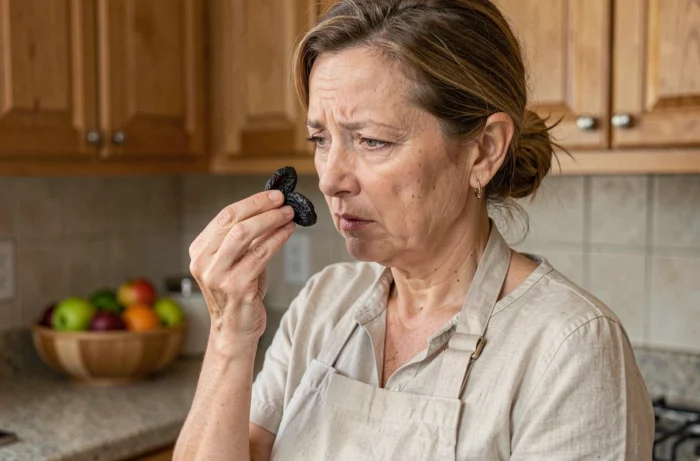
Relying solely on the absence of visible mold is insufficient. The evaluation combines three successive sensory examinations: visual, olfactory, and tactile.
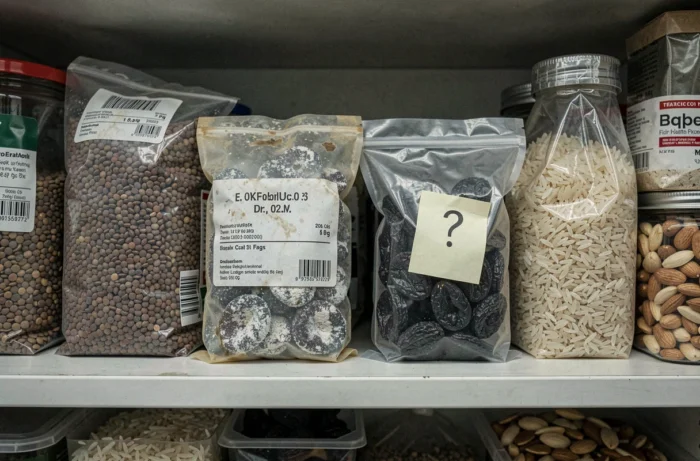
- Visual examination: look for white, green, or gray spots on the surface, as well as an abnormal shiny appearance that may indicate superficial fermentation or the beginning of sugar crystallization (a benign phenomenon, not to be confused with mold).
- Olfactory examination: a sour, fermented, or alcoholic smell indicates microbial activity. A healthy prune emits a sweet, slightly caramelized odor. Any acidic note justifies discarding the batch.
- Tactile examination: a prune that has become abnormally sticky or tacky beyond its usual texture has likely undergone degradation. Softening alone, without other signs, indicates a loss of quality rather than danger.
If any of these three signals are positive, the product must be discarded, regardless of the date on the bag. Conversely, a prune that passes these three tests remains consumable several months after its MDD.
Storage after opening: the factor most guides overlook
We observe that the majority of online content treats the storage of prunes as a minor topic. However, storage after opening is the critical moment.
An airtight container, made of glass or rigid food-grade plastic, limits moisture uptake much better than a bag resealed with a clip. Transferring to an airtight jar immediately upon opening significantly extends the consumption duration.
Temperature and location
A dry cupboard, away from the stove and dishwasher (sources of steam), is the appropriate location. The refrigerator is an option for hot climates, provided a perfectly airtight container is used. The internal humidity of the refrigerator, if the container is not airtight, accelerates degradation instead of slowing it down.
Temperature fluctuations pose a problem often ignored. Taking the jar out of the cupboard, leaving it on the counter for an hour, then putting it back creates condensation inside the container. This micro-condensation, repeated daily, is enough to reactivate surface water activity.
Expired prunes and nutritional quality: what actually degrades
The fiber content of prunes, particularly in polyols and insoluble fibers, remains relatively stable after exceeding the MDD. Fibers do not degrade at the same rate as micronutrients.
What gradually decreases are certain antioxidant compounds and some vitamins sensitive to oxidation. The caloric value and fiber content remain almost identical for several months after the MDD, while the micronutrient profile slowly diminishes.
The accelerated browning of the flesh, sometimes visible on very old prunes, results from non-enzymatic Maillard reactions between reducing sugars and amino acids. This phenomenon is not toxic but alters the flavor towards more bitter notes.
Sugar content and fermentation risk
Prunes contain a high proportion of sugars. In an environment where the Aw rises, these sugars become the ideal substrate for osmophilic yeasts, capable of developing even at high sugar concentrations. The result is fermentation that produces ethanol and CO2, detectable by smell and sometimes by swelling of the bag.
A swollen bag is an immediate disposal signal, even if the product appears visually intact. Gas production indicates advanced microbial activity.
MDD and UBD on dried fruits: French regulatory framework
In France, dried fruits like prunes fall under the MDD, identified by the mention “to be consumed preferably before.” This wording, framed by European food labeling regulations, explicitly means that the product can be sold and consumed after this date.
The UBD, indicated by “to be consumed until,” applies to perishable goods (meats, fresh dairy products, refrigerated prepared meals). Confusing MDD and UBD leads to discarding perfectly consumable dried products.
Prunes are among the most frequently discarded foods due to excessive caution. Food waste related to this confusion represents a significant volume in French households, while these products are among the most stable in the pantry.
A prune stored in unopened packaging, kept in a dry place at a stable temperature, poses no documented health risk several months after its MDD. The only relevant assessment remains sensory: appearance, smell, texture. If these three parameters are satisfactory, the product can be consumed without reservation.