
A pregnant woman hospitalized for a retroplacental hematoma often receives a simple instruction: stay lying down. The immediate question that follows is in what position. Placental detachment requires strict rest, and the posture adopted during sleep directly influences blood circulation to the uterus and placenta. Choosing the right position is not just a comfort detail; it is a measure that contributes to the overall monitoring of the pregnancy.
Why sleep position matters in the case of placental detachment
When we talk about placental detachment, we refer to a partial or total separation of the placenta from the uterine wall. Blood accumulates between the two, forming a hematoma that reduces the exchanges between the mother and the baby. In this context, any compression of blood vessels worsens the circulatory deficit.
The inferior vena cava, which returns blood from the lower body to the heart, runs along the right side of the spine. In a pregnant woman, especially in the third trimester, the weight of the uterus can compress this vein when lying on the back. Venous return drops, blood pressure decreases, and uterine blood flow diminishes. For a placenta that is already partially detached, this reduction in flow is problematic.
Here we find the same mechanism that leads healthcare professionals to discourage supine positioning at the end of pregnancy, but with a more acute issue when a retroplacental hematoma is already present. Recent obstetrical recommendations emphasize maternal stabilization and continuous fetal monitoring more than a single posture, which shows that sleep position is part of an overall medical protocol, not an isolated solution.
To delve deeper into sleep positions in the case of placental detachment, several postures can be distinguished along with their concrete effects on uterine circulation.

Left lateral position: the reference posture for pregnant women
Sleeping on the left side remains the most recommended position. By lying on the left, the inferior vena cava is freed from any compression by the uterus. Blood circulates better to the placenta, and renal perfusion improves as well, which helps reduce edema.
How to settle in concretely
The posture is not just about rolling onto the left side. To be sustainable for several hours, minimal adjustments are needed:
- A cushion (such as a nursing pillow or bolster) placed between the knees to align the pelvis and avoid lumbar twisting. Without this support, the upper hip pulls forward and creates uncomfortable pelvic tension.
- A second cushion or a rolled blanket under the belly to support the weight of the uterus. This support reduces tension on the round ligaments and decreases pressure on the detachment area.
- A slight incline of the torso (additional cushion under the shoulder and head) if acid reflux complicates the night. The incline should not reach a semi-sitting position unless specifically advised by a doctor.
The right side is not prohibited, but it offers lesser circulatory benefits. It can be alternated occasionally if pain in the left hip prevents sleep, provided one does not stay lying on the back for long between the two positions.
Positions to avoid in case of retroplacental hematoma
Some postures, tolerable in early pregnancy, become risky when a placental detachment is diagnosed.
Sleeping on the back in the third trimester
Supine positioning compresses the vena cava, as noted, but it also reduces the flow of the abdominal aorta. The result is twofold: less blood reaches the uterus and maternal venous return decreases. Signs such as dizziness, nausea, or a feeling of discomfort when lying on the back signal this compression. If one wakes up on the back, simply turning onto the left side without panic is sufficient.
Sleeping on the stomach
Beyond the first trimester, this position is physically difficult to maintain. With a placental detachment, direct pressure on the uterus is contraindicated. This question rarely arises in practice in the third trimester, but it may concern women diagnosed earlier in their pregnancy.
Monitoring and limits of posture alone in facing placental detachment
It would be a mistake to think that sleep position alone is sufficient to stabilize a placental detachment. Current clinical guidelines prioritize monitoring coagulation status, particularly fibrinogen levels, as key indicators in the event of third-trimester hemorrhage. The nighttime posture is a complement, not a treatment.
In case of bleeding, the first reflex is to contact one’s healthcare professional. A little-known point: digital vaginal examination should be avoided until a placenta previa has been excluded by ultrasound. This is a precaution that patients are not always aware of and can prevent worsening.
For Rh-negative women, the administration of anti-D immunoglobulin is part of the management measures in case of bleeding related to detachment. This is not directly related to sleep position, but it serves as a reminder that active medical follow-up takes precedence over any postural adjustments.
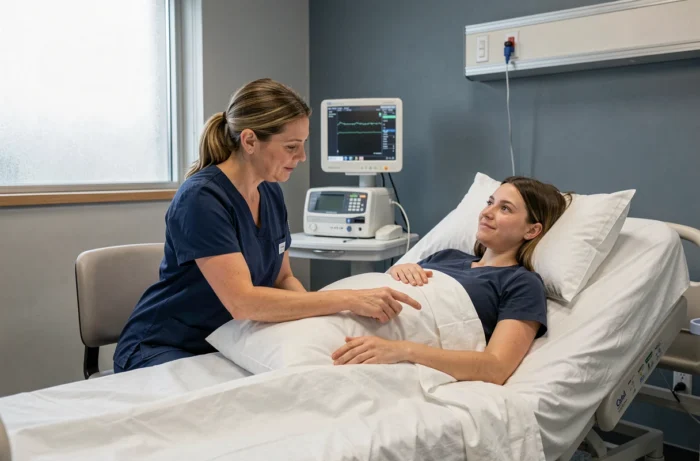
When lying down rest becomes hospital-based
The degree of rest varies greatly from patient to patient. It ranges from simple work stoppage with a few hours lying down per day to complete bed rest in a hospital setting with continuous monitoring. Experiences vary on this point: some women spend several weeks bedridden at home without worsening, while others require emergency extraction despite strict rest.
In any case, the left lateral position remains the foundation. It does not guarantee favorable evolution of the detachment, but it optimizes what can be improved on the maternal side: uterine blood flow, venous pressure, and the comfort necessary to endure prolonged bed rest.
Placental detachment remains an obstetric emergency whose management goes far beyond nighttime posture. Adjusting one’s sleep position is acting on a real but limited parameter. Regular follow-up by a healthcare professional and responsiveness to any new bleeding remain the two pillars that truly determine the outcome of the pregnancy.